TCM Makes Summer School Cool w/ Free Film Noir Course

This sounds great! I plan to sign up for this course, who about you?

willmckinley's avatarcinematically insane

Lizabeth-Scott-and-Dick-Powell-in-PitfallFor a generation of fans old and new, Turner Classic Movies has been like film school without the student loans. Now, more than two decades after the channel’s launch, you can remove like from that sentence.

On June 1, TCM will become an actual educational institution (of sorts) when it launches Into Darkness: Investigating Film Noir, a on-line course presented in conjunction with Indiana’s Ball State University. The nine-week eLearning class will explore “the means, motives, and opportunities that led Hollywood studios to make these hard-boiled crime dramas” and will be taught by Richard L. Edwards, Ph.D., co-author of The Maltese Touch of Evil: Film Noir and Potential Criticism and co-host of the Out of the Past: Investigating Film Noirpodcast (with TCM staffer Shannon Clute).

And best of all, the course is entirely free – and it’s open to non-TCM subscribers. (TCM promises “free links to online public domain films noir…

View original post 421 more words

Review: Talaash The Answer Lies Within

Talaash is a neo noir from Bollywood revolving around 3 characters with Aamir Khan’s Inspector Surjan Singh Shekhawat being the central character.  The other two are his wife played by Rani Mukerji and a prostitute and our femme fatale for this tale played by Kareena Kapoor.

Our story starts with a tour through the red light district as our credits role.  We soon come to a beach side road and a car swerving for an unknown reason and flying into the water.  Our hero gets the case and soon finds out the victim is a popular Bollywood movie star.  We find out the car was in good working order, he had no drugs or alcohol in his system and he died from drowning.  Why did he swerve off the road?  What was he doing down in the red light district at 4 in the morning by himself?  The plot thickens as we soon meet a pimp who was with the star that night and he soon disappears.  We learn from the  dead movie star’s girlfriend that he recently had his accountant give him a large sum of money that night as well.  Where did the money go?  Our main character and detective on this case, has recently lost his young son in an accident.  He blames himself for this and this causes tension between him and his wife.  He soon turns to our femme fatale for support and help with the case.  What is her part in this case?  What does she know?  What isn’t she telling our hero?  Can our hero resist her charms?

The more we go the more we question what is going on in this film.  It is well written and does make sense all in the end.  In fact this may be the best plot twist and writing I’ve seen in a while.  This movie deals with a lot of death and loss for all the characters and how they react to those loses.  The mystery is strong and the cinematography is very good.  I’m not going to lie, all the Bollywood movies I’ve ever seen feel a little campy and though in parts this one does too, it is the least campy film from India I have seen.(Not that I have seen a lot of Indian films.)  We don’t have anybody break out in song and dance, though there are some music montage moments.  There isn’t any over the top special effects, though there are a few that push the limit.

This is worth a watch for any foreign film fan and neo noir fans.  The twists and turns are hard to see coming and are well executed.  It definitely isn’t a traditional noir story and I think that is a good thing.

Review: Fourteen Hours

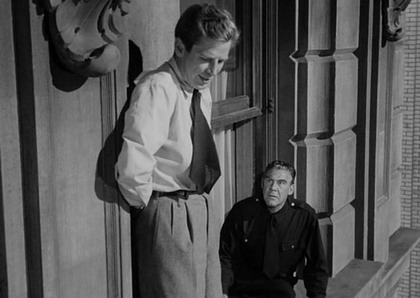
14 Hours is a film noir from director Henry Hathaway and a screenplay by John Paxton based on a story by Joel Sayre.  The story revolves around a police officer played by Paul Douglas and a man on a ledge threatening suicide played by Richard Basehart.

This story starts with our police officer on the street giving out parking tickets when he notices a jumper on the ledge of a hotel.  He goes up to talk to him and is the first cop on the scene.  He talks to our jumper for a bit before the higher-ups get there and tell him to go back down on the street.  Our jumper soon says he will only talk to the original police officer so they go and find him on the street and bring him back up to the ledge. Will our hero flat foot cop be able to save the day and talk our jumper down?  Why is our jumper on the ledge?

Barbara Bel Geddes shows up as our jumpers girl and Agnes Moorhead also stands out as the over bearing mother of the jumper.

We also get some minor stories from the people down on the streets of New York.  This shows the effects of this spectacle on those folks.  One of these small sub plots is what made me so excited to see this.  We have Grace Kelly in her first film role, as a wife on her way to a lawyer’s office.  We see flashes of future brilliance here as the jumper has blocked traffic and made her late.  Then as she is across the street in the lawyer’s office she can see the jumper on the ledge out the window as she waits for her meeting to start.  I don’t know how I missed this film with her in it.  I went through a Grace Kelly phase after seeing Rear Window for the first time and had to see everything with her in it.  This one slipped under my radar some how.  I guess I still am in a Grace Kelly phase, but who isn’t?

Another sub-plot is the taxi drivers who are basically stuck in traffic and out of work for the day.  We also have a young women who would like to help but doesn’t know how.

The way this was filmed is really well done.  We have some great shots from the street up to the jumper and some from high up in the building down to the crowds on the street.  It has some very interesting cinematography worth checking out.

This is a slightly above average film and average film noir worth watching for Grace Kelly fans, even if it is a small role.  Classic noir fans will like it as well and those wanting to see what New York City looked like in the early 1950’s.

Favorite Tidbit:  Though 2012’s Man on a Ledge is not a remake, it does have a lot in common with this film.  Both take place in New York on a hotel ledge.  I also noticed a lot of the same quotes and similar actions of the New York crowd on the street.  Man on a Ledge is also a very good film I will have to re-watch and review it soon.

Book Review: The Carrion Birds by Urban Waite

They say you can’t go home again, and man this book drives that point home with a gun shot to the gut.  This book was released in 2013 and has been on my radar for sometime.

Our protagonist is Ray who has left his hometown 10 years ago.  We slowly learn through out the book why he left in little flashbacks to the fateful time.  Ray has some military experience, and I felt this was important to the character’s background.  This explains why his boss hired him to begin with, his sense of loyalty to his family, and his never die attitude.

Tom is Ray’s cousin and is also an interesting character.  He was the Sheriff of Coronado, New Mexico our hero’s hometown.  He was kicked off the force 10 years ago and has been trying to get back on the police force ever since.  We soon find out the 10 year mark that we see Ray leave town and Tom lose his job are because of the same event.  Tom and Ray are the same age and though they are cousins they grew up very close and are more like brothers.

This story starts out with Ray taking one last job, classic last words in the world of noir.  Ray is to do one last heist with his bosses inexperienced nephew.  They are to heist a large amount of drugs near Coronado, this will give Ray a little money to start fresh back in his hometown and the 10 years away should have been enough time for things to blow over.  When the heist goes down, Ray recognizes the driver and soon realizes things are not going to be as easy as he imagined.

As Ray tries to finish his job so he can start over and get his family life right, things just continue to go wrong for him.  We also find Tom torn between doing the right thing so he can work his way back onto the police force or helping his cousin do what he needs to.

It took me longer then normal to get through this book, partly due to spring activities and partly because I could easily tear myself away from this book to do other things.  This wasn’t the page turner I was hoping for, this took some effort to read.  The story is very good and so is the story telling, but it did take me some extra effort for the payoff.  I think this is for fans of  people who like Cormac McCarthy.  I’m not the first to say this about Waite and maybe that stuck in my mind, but it seems to fit.  This book is in development to be made into a movie.  I hope this isn’t put in development purgatory like a lot of great books out there, because I think this could make a great film in the right hands.

Review: Homicide

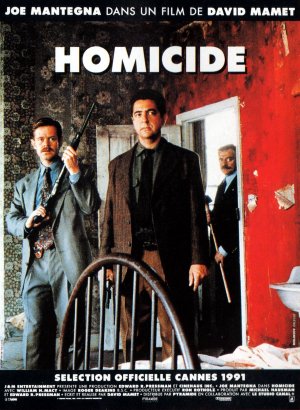
Homicide is a neo noir from 1991 by modern film great David Mamet.  Mamet who wrote and directed this film has also wrote a ton of great neo noir and crime films over the last 4 decades.  He writes some of the best dialog around with a rhythm to it that is hypnotic.  It is street level crime poetry, and the flow and delivery from some of the best actors around.  This is the first time I’ve seen this film, but it won’t be the last.  I’m not sure how I missed this in the early 90’s at the video store, or never really heard much about it.  It popped up on a few neo noir lists and when I seen who stared in it as well as it being a Mamet film, I put it to the top of my Netflix Queue.

This film revolves around Joe Mantegna as our Homicide Detective lead.  He is tough, but tough in a different way than our normal hardboiled detective.  He uses his people skills and smarts rather than his fists and gun.  In fact we see a number of pivotal scenes where his physical strength is tested and he fails these tests.  We also see him get back up and keep trucking along.  This film has a lot of racial tension as well.  Our hero is Jewish and seems to shun this at first, but later is torn between being a great cop or a good Jew.

William H. Macy plays Mantegna’s partner and their dialog and banter is some of the best in modern noir.  Macy is always good and doesn’t disappoint here. He plays the sidekick who doesn’t question anything his partner does, because to him, his partner can do no wrong.  Will this be his downfall?

This story starts with an F.B.I. raid on an apartment, they kill an innocent black women and their suspect gets away.  It’s a mess the F.B.I. dumps on the local Homicide division.  Our two detectives take the case, with a lead they think will pan out.  On the way to apprehend the suspects brother to see if he will roll over on his brother, we come to some flashing lights and a cop in need of some help.  As Macy takes the car and goes on to the planned meet with the suspects brother, Mantegna stays behind to help the uniformed police officers.  An old Jewish women has been shot with a shotgun and her store robbed.  Mantegna catches the case and is taken off the more high-profile original case.  He continues to juggle the two cases.  On one hand he is helping his people solve the murder case of a Jew.  On the other he is trying to find the black man the F.B.I. is desperate to find.

This has some great actors in this besides our two leads.  Though all are great in this, the two small parts that stand out to me are Ving Rhames in one of his earliest movie roles as the black suspect the first case revolves around, and Ricky Jay as one of the members of the Jewish community the second case revolves around.

The movie isn’t just noir in story but also is filmed in a classic film noir style, using washed out colors and shadows through out.

I really loved this film and think noir lovers of the classic era as well as the modern neo noir lovers will like it too. This film has more to say then a simple murder mystery and touches on racial tensions not only between whites and blacks but the Jewish community as well. I look forward to watching and re-watching more from Mamet for this site in the future.

Review: Heat Wave or The House Across the Lake

Heat Wave is another B-movie noir from famed British group Hammer Films.  This is written and directed by Ken Hughes based on a book he also wrote.  Hughes went to Hollywood and made some big films, his most notable isn’t even close to the dark noir he made here, a little film by the name Chitty Chitty Bang Bang.

This film showcases Hillary Brooke, a quintessential femme fatale in every way.  We have more than one man in her web and she doesn’t let any of those men escape through out the whole film.  She is definitely the high spot of this film and the main reason to watch this one.

The story starts with our protagonist played by Alex Nicol holed up in a cabin on the lake shore.  He is there to write his new book, but he has a bit of writers block.  He gets invited to a party across the lake where we meet our femme fatale and her husband played by Sidney James.  We soon find out our femme fatale has a boyfriend on the side and seems to be flaunting him in front of her husband and anybody else that might care.  Our protagonist and the husband become quick friends and we soon find out our husband is dying, he has about a year.  He also plans to change his will.  Our husband happily pays the bills while he is alive, but he will be damned if he will pay the bills for his cheating wife once he is gone.  His lawyer is on a trip in America and he plans to change his will as soon as the lawyer comes home.  Our protagonist writer loses his contract and is flat broke, he is also the new target of our femme fatale.  Will our hero team up with our femme fatale to kill her husband before the will is changed?  Will he save his friend from his deadly wife?  Will our femme fatale find somebody else to help her kill her dying husband before he changes his will?  He’s dying anyway and she deserves her fair share of the estate, right?

This is a pretty straight forward mid 50’s classic noir.  We are not covering new ground here by any means.  It is cheaply done, but it still has a great noir look.  The story builds for about 7/8 of the film and actually felt like an above average noir, but the story kind of falls apart at the end.  It is still worth viewing for hardcore classic film noir lovers and has its high points.  If you are new to the genre, you may want to start elsewhere, but if you see this on the tube late one night, give it a try, it may surprise you.

Re-watching the Classics: The Conversation

The Conversation is a neo noir film from Writer and Director Francis Ford Coppola.  This film may get lost in the mix of great Coppola films, but it is right up there with his best.  Honestly, the first time I seen this, I didn’t get what all the fuss was about, but after re-watching it, I think I get it now.  This is more of a slow burn that continues to turn up the heat as we go.

The cast is amazing with the movie revolving around Gene Hackman who plays somebody totally different than our hardboiled detective role we looked at in The French Connection and Night Moves earlier on this site.  He plays a surveillance expert, who happens to be a little paranoid, maybe he should be.  He is the best at what he does, but soon wonders if he should be doing it.  He also sees how easy somebody can do the same to him and this I feel drives his paranoia more.

The rest of the cast play small parts, but Coppola seems to have a knack of getting high level talent for these parts.  One stand out is Harrison Ford, this is one year after his break out performance in American Graffiti, but he wasn’t quite the biggest star on the planet yet, Star Wars was still 5 years away.  We also have John Cazale, Cazale only appeared in 5 films, all in the 1970’s, before his untimely death.  They just happen to be 5 of the best films of the decade.  We also have a young Frederic Forrest and Cindy Williams as our targets of the surveillance.  We see Terri Garr in an important scene and Robert Duvall and Billy Dee Williams in such small roles they went uncredited and didn’t even have lines!

Our story starts with Forrest and Williams in a square having what seems to be an innocent conversation on their lunch hour.  We soon see Hackman and his team at different posts around the square, using different recording devices to record the conversation.  We then have a scene where Hackman comes home, he has a number of locks and an alarm on his apartment and when he opens the door, there is a bottle of wine for his birthday.  You see how this drives Hackman crazy, even with all this security the land lord easily gets into his apartment to drop off the wine.  The next day he goes to his warehouse and starts working on piecing his recording together to get the whole conversation.  Once he is finished, he sets up an appointment to deliver the final product to the man who hired him.  That man is not in and his assistant, played by Ford, tries to pay Hackman for the tapes.  Hackman feeling paranoid again decides to wait to deliver it to the man who hired him.  The story takes off from there, as we meet some of Hackman’s competitors at a convention and he tries to figure out what is on the tape exactly and why do people want it so bad?

This movie is a statement on how technology is not always the best thing and can cause more trouble then it is worth.  I can’t imagine what Coppola would have to say if this film was made today, but I would love to see it.  Though the technology is primitive by today’s standards it still has something to say about our world.  Is too much information a good thing?  Are we becoming paranoid as a society?  Should we be?

This film should be seen by any film buff, whether you are a noir fan or not.  If you didn’t see why it is so great on your first viewing, give it a second chance.  I did and I’m glad I did.  This is a film that could be watched multiple times as little nuances can be found each time.

Re-watching the Classics: The Set-Up

Here is a short film noir of only 73 minutes long, which takes place over those same 73 minutes.  This is Directed by Robert Wise and stars Robert Ryan as our main character.  Ryan plays Stoker, an over the hill boxer hoping to make one last run as a fighter.  Audrey Totter plays Stoker’s wife who wants him to stop fighting before he is hurt to bad. We start out with our couple in their apartment as Stoker gets ready to head to the arena.  He gives his wife a ticket to watch the fight, she makes one last effort to stop him from fighting to no avail.  Stoker gets into the locker room to start getting ready for his main event fight.  We meet a varied crew of fighters in different stages of their career.  It is almost like Stoker is reliving his past and looking into his near future as the fighter come and go, before and after their bouts.  We get to see so many great character actors of the classic noir era in this locker room.  Names such as George Tobias, Wallace Ford, Percy Helton, James Edwards and David Clarke.  We have a hodge-podge of fighters, trainers, promoters and gangsters coming and going through out the night. Stoker’s team and his opponents team have agreed that Stoker will throw the fight for the gangster named Little Boy played by Alan Baxter.  The problem is, nobody told Stoker!  Will he learn before it is too late to throw the fight?  If he does learn about the set-up will he agree to do it?  Will Stoker’s wife show up to watch the bout? As I have stated before, the more I watch Robert Ryan’s films the more I like him.  He did such a wide range of characters, it is hard to believe he could be so versatile.  The only common thread when Ryan is in a film, he will always be tough as nails.  This film is so unique and so great, I think everybody should see this at least once if you are a film lover at all.  If you are a noir fan it is a must see and if you like Ryan you probably already seen this, if not drop everything and do it now! Do you think this was a big influence on Quentin Tarantino’s story line in Pulp Fiction revolving around Bruce Willis’ character?  I can’t help but see many similarities between Willis and Ryan’s characters.  What do you think?

Review: Barton Fink

Even though I’m a big fan of the Coen Brothers, this is the first time I’ve ever watched this.  I guess the story never really appealed to me, but I always knew I would get around to watching this sooner or later.  This kept popping up on lists of neo-noir films, so I thought it was about time to watch it and give it a review on here.  Would this hold up to my Coen Brothers favorites like Fargo, Blood Simple, The Man Who Wasn’t There and Miller’s Crossing?  This was actually written when Joel and Ethan Coen had writers block while writing Miller’s Crossing.  I recently reviewed this often overlooked classic here:

https://everythingnoir.com/2015/02/15/re-watching-the-classics-a-fresh-look-at-millers-crossing/

Our story is about Barton Fink, played by John Turturro, a writer from New York who soon finds himself in Los Angles to be part of the Hollywood machine.  He check’s into a hotel where he meets his neighbor Charlie Meadows, played by John Goodman.  Fink is hired to write a script for a wrestling film and he has some writers block.  We meet a wide range of Hollywood types throughout the film.  It is a wild ride, but to be honest we don’t get into the noir part of this film until the second half and though we get a bit of a twist, its pretty minor.

On thing I noticed watching this, is the list of amazing actors in this film.  The other is we get no matinée idols here, just a cast of great performers who are their based on their talent and not on their looks.  This is something we don’t see very often.  Some of the actors we see here are Michael Lerner,John Mahoney,Tony Shalhoub, Jon Polito and Steve Buscemi.

This film has a lot of hidden meaning and almost feels more like a David Lynch film then a Coen Brothers film.  For instance the theory that the hotel is actually hell.  Keep that in mind next time you watch it and see what you think.  The ending also made me feel like something out of a Lynch film as well.

Even though it isn’t a pure neo-noir film like some of Coen Brother’s other films, it is a very good film.  The Coen’s make the hotel and old Hollywood look great, the story is interesting(you wonder how much of this film comes out of the Coen’s frustration with the Hollywood system), and it is a thinking man’s movie.  If you are new to Coen Brothers films, I would start with the four films I listed earlier.  If you already have seen most everything from these guys but haven’t seen this yet, you should give it a try.

Favorite Tidbit: John Mahoney’s character is based on William Faulkner.  Faulkner’s first work in Hollywood was for a wrestling movie.  Barton Fink was based on Clifford Odets, a screen writer in Hollywood in the 1940’s and 1950’s.  He wrote screenplays for some great films including everythingnoir.com’s favorites Deadline at Dawn and Sweet Smell of Success, as well as a few other great noir films we will look at.