
The Woman on the Beach is a film noir from 1947 directed by Jean Renoir. We have Joan Bennett as our femme fatale and Robert Ryan as our duped hero. Charles Bickford plays our disgruntled blind husband of Bennett. This is a short film of only 71 minutes long and a fairly simple plot with out much wow factor.
This film starts out very strong with Ryan having a nightmare. The nightmare is strange and wonderful, with some cool camera effects. Ryan plays a Navy man who has seen some bad things. Today we would say he has Post Traumatic Stress Syndrome. He wakes from his nightmare as his bed’s head frame and shadows on the wall show he really is in a prison of his own mind.
He travels along the beach where Bennett catches his eye, though he doesn’t stop or acknowledge her, we see there is some electricity there. He continues on his intended path to talk to his girlfriend, played by Nan Leslie, to see if she will marry him. Is this a last-ditch effort to save himself from going mad?

Even though Ryan has just become engaged, he still finds an attraction to Bennett who he learns is married. Ryan soon meets the husband who is a famous artist, except he has recently gone blind. Bickford plays the blind artist who is a very interesting character. He is abusive to his wife, maybe taking out his frustrations on her? As the movie goes along we find the couple to be in a co-dependent relationship. Bickford takes a liking to Ryan, or does he just want his enemy close?
Ryan believes Bickford really isn’t blind but is pretending, to keep Bennett close to him. This all sounds great, but it seems to trail off from here with out to much of a plot. I think this film would have been much better with a little more plot towards the end and a slightly longer run time. Ryan is great as usual, playing an average man back from the war. Bennett is good as our complex femme fatale, using men to get what she wants, but does she really know what she wants? Bickford is also very good as the bitter husband that has lost everything important to him, but is trying to adapt.

This is a decent film worth watching. It has three great characters and starts out with a strong study of those characters. This first half hour is very intense and you feel like you are on your way to watching a hidden gem, but the second half fell a little flat to me. Still worth watching for film noir buffs and fans of the three leads.


 Journey Into Fear is a classic film noir from 1943 from Orson Welles. Welles didn’t direct this, Norman Foster did. Welles didn’t write the screenplay, he had the star of the film, Joseph Cotten do that. He does have a small role in this film, but isn’t on the screen that long. He doesn’t even have a producing credit for this film. So why do most consider this a Orson Welles film? Well, though he gave out the brunt of the work to others, he really did produce it, he also helped Cotten write the screenplay based on the book by Eric Ambler and he even re-shoot a new beginning and ending for the film. He just gave full credit to those he hired to do the job. This story follows ammunition engineer Howard Graham, played by Cotten, in Turkey on business during World War II. He meets with the Turkey business representative for his company and leaves his wife, played by Ruth Warrick at the hotel. Him and the business rep go down the street to a night club where we meet a dance couple played by Dolores del Rio and Jack Durant. Graham is also volunteered against his will to participate in a magic trick. Graham is strapped to a board as the magician gets into a box. The lights go out and a gun shot rings out in the crowd. The lights come on and the magician is strapped to the board with a gun shot wound and Graham emerges from the box. Graham knows right away that he was the intended target, as he and the rest of the club are sent to see Colonel Haki played by Welles to determine what really happened. Haki puts our hero on a boat that night to hide him from the German’s who are trying to kill him. We meet a whole other assortment of odd characters on the ship. Including the unhappy Matthews couple played by Frank Readick and the always good Agnes Moorehead. Our dancing couple is also on the ship and del Rio really takes a liking to our hero. Graham soon realizes the Nazi’s have made their way aboard the ship as we get a claustrophobic feeling of impending doom. Will our hero get off the ship safely? Will he ever re-unite with his wife? One of my favorite performances of this film is the silent killer played by Jack Moss. He was a successful movie producer at the time and Welles wanted to use him as the killer in this film. He said he would do it if he didn’t have to speak. He didn’t and was as menacing as any killer in a 70’s slasher film.
 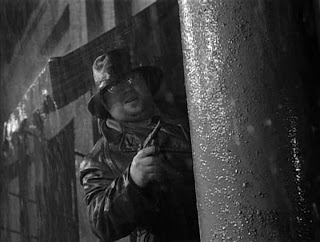 The opening scene, with a totally silent Jack Moss really grabs your attention and set the tone and mood for the rest of the film. It is a shame this is Moss’ only on-screen role. I would have loved to see him in more stuff. This film was not well received on its release. Welles even has said he was not happy with the film and he had a horrible performance as an actor in it. That being said it was an important early noir film in style and story. I actually really liked this film, even more than some of Welles’ other more regarded works.
  Favorite Tidbit: Though most everybody was not happy with this film, from the studio to Welles himself. The one person that was very happy with this film was the author of the book, Eric Ambler. He said the movie was so different from his book, that he could re-sell the rights to the book to a different studio and make some more money on it.


 everythingnoir