Review: Illegal

Illegal is a film noir from 1955 starring film noir great Edward G. Robinson.  This film is also one of the first films of Jane Mansfield’s short career.

The film is directed by Lewis Allen and a screenplay by noir writers W.R. Burnett and James R. Webb based on a story from Frank J. Collins.  This is the third time Collins’ story was brought to the silver screen.  I’ve never seen the other two films, so I can not compare the three.

This movie starts out with Robinson as a District Attorney winning a case.  We see the man convicted going to the electric chair.  Robinson is rushing to the hospital where he is given a death-bed confession.  He calls the prison and is too late, they have executed an innocent man Robinson got convicted.  Robinson quits the office and soon becomes a defense attorney.  He is also in love with his assistant, played by Nina Foch who stays at the D.A.’s office and marries another man played by Hugh Marlowe.  Robinson uses his great skills to win cases for some of the worst criminals in town.  This shows one case after another, won in grand fashion by Robinson.  The last case of the film is a very personal one for Robinson’s character and it cranks up the tension and grittiness of the film.

This film is obviously at a  lower quality level then we are used to from Robinson.  Robinson of course was in some of the greatest pre-noir gangster films and a list of some of the best films noir of the 1940’s.  He was then caught up in the McCarthy Un-American Activities Committee.  He testified and was absolved of Communist activities, but was never in anymore great films.  He did elevate films like this one but was never able to re-gain his standing as one of the biggest stars in Hollywood, playing minor parts in big movies and big parts in small movies.

This is still a good film worth watching for Robinson fans and classic film noir fans.  Though it isn’t the same quality of story and production of his earlier stuff, it is still a highly enjoyable performance and film.

Favorite Tidbit:  Edward G. Robinson’s character is loosely based on the famous lawyer Bill Fallon, “The Great Mouthpiece” who got gambler Arnold Rothstein off for the “Black Sox” of 1919 World Series fix.  His likeness has appeared in a number of films and television series over the years.

Review: Where the Sidewalk Ends

Where the Sidewalk Ends is a classic film noir from 1950 directed by noir great Otto Preminger.  We have more noir greatness in the two leading stars, Dana Andrews and Gene Tierney.  All three worked on Laura, returning to work together 6 years later on this film.  This is based on a book by William L. Stuart

Some of the small roles that stood out to me is Gary Merrill as our mobster boss and Karl Malden as the cop who just got promoted to lieutenant over Dana Andrews.

This story starts out with Tierney who is accompanied by two other men playing an illegal game of craps.  One of them is winning big, real big.  He is up $19,000!  Tierney starts to go home and one of the men says they can not go yet.  He smacks her and the man up $19 grand punches him.  The two men fight and our lucky gambler is left unconscious on a couch.  We then go to the police headquarters where a murder is reported.  Andrews and his partner leave to investigate the case.  They find the luck gambler dead on the floor, stabbed in the heart.  This is in Merrill’s room where the illegal craps game was being played.  We soon see Merrill and Andrews do not like each other and have a history.  Andrews goes to the apartment of the other man who was with Tierney and who Merrill says killed our gambler.  There is a fight and Andrews accidentally kills his only suspect in a fist fight.  Now Andrews has to cover the murder he committed. Will he get away with it?  Will Merrill get away running his illegal game and possibly murder himself?  How will Tierney react to all of this?

This is another great noir from Andrews, Tierney and Preminger.  I felt it was a darker more gritty noir then Laura and well worth watching.  The fight scenes are not flashy and play more realistically then what we get today.  The style of the film is  quintessential noir.  This was Preminger’s last of 4 noir films he made for 20th Century Fox in the 1940’s and is one of the best.  He went on to make more noir, crime and thriller films well worth watching for other studios.  This film is a must see for all classic film noir fans and all fans of film should give it a viewing.

Review: Side Street

Side Street is a film noir from 1949, directed by Anthony Mann based on a story and a screenplay by Sydney Boehm.  This stars Farley Granger as our protagonist and Cathy O’Donnell as his pregnant wife.

This story is confusing and full of plot holes but a fun noir to watch.  This film starts with a women blackmailing some important business man.  A guy behind a door has a gun to make sure this goes down like it is supposed to.  We then find this girl floating in the water, dead!  Granger is working as a part-time mail carrier(because a full-time mail carrier would be too honest to do this?)  He delivers mail to a lawyer’s office and finds a sign which says “out for 15 minutes and will be back soon”.  Granger finds the door is accidentally left unlocked.  He goes in the office and tries to open a filling cabinet, it is locked.  So he leaves, sees an ax for firefighting and brings it back to open the cabinet.  He grabs a file, puts into his bag, not looking at it, and takes off.  Now a voice over for the film is telling us our mail carrier has 50 cents in his pocket and would or wouldn’t you in that situation steal a few hundred dollars? There ends up being $30,000 in the file. This is where you have to start suspending your rational thinking!  Why would a lawyer with $30,000 in his office not lock the door?  But that is not the biggest questions here! How or why does Garager know that in the second drawer down, the last file in the cabinet has any money in it at all?  He grabs it without looking in the file and without looking in any other drawer or file?  Why does he think there is a few hundred dollars in it and not more, or any for that matter?  Anyway he dumps the file, goes to his parent-in-laws where him and his wife now live, because they have lost everything in a failed business and are starting over.  His wife is pregnant and due anytime now.  He gives her some cash and says she can now get a real doctor and a room at the hospital to have her baby.  He tells her, he got a new job up north and a pay advance and has to leave right away to start work.  He gives the cash to a friend telling him it is a present for his wife and needs to hide it with him so she doesn’t find it.  So as the plot thickens our hero has the police, a lawyer and some murdering blackmailers all looking for him while he runs through the streets of New York City to give the money back to its rightful owner and figure out the mystery on his own.

So this synopsis is just part of the suspend disbelief you need to enjoy this film.  If you do I think you will enjoy the ride.  It is stylishly filmed and even though you don’t always know quite what is going on and why, it is a fun watch.  We also get a few cameo appearances worth seeing.  Jean Hagen plays a lounge singer, who is our closest thing to a femme fatale in this film. Charles McGraw plays a small part as a deep voiced hard-nosed cop.  Also Paul Kelly as our police captain is very good.

I think most film noir fans will find this film enjoyable, I did.  Sometimes life doesn’t make sense so why should a classic film noir?

Review: He Ran All the Way

He Ran All the Way stars John Garfield in his last role.  Garfield died of coronary thrombosis at the age of 39.  Garfield was a prominent actor in the classic noir period.  Shelley Winters also stars as the female lead early in her illustrious career. Character actor Wallace Ford also appears as Winters’ father.  This film is based on a book by Sam Ross and directed by John Berry.  The film was released in 1951, five years after Garfield’s most famous role in The Post Man Always Rings Twice.

This film starts out with Garfield and his partner robbing a payroll.  They are chased and Garfield’s partner is shot.  Garfield gets away, but shoots a police officer in the process.  He escapes to a public pool and literally runs into Winters.  He quickly knows she may be his way to hide out.  They go back to her apartment where we and Garfield learn she lives with her parents and little brother.  The police officer dies and Garfield is all over the papers as the killer.  Garfield takes the family hostage while he hides out there.  Will Garfield get away with the loot?  Will Winters fall for him as they go off together to live happily ever after?  Will Garfield kill any of the members of the family before he gets away?  Will Garfield even get away?

The tension is strong for this classic and works very well.  It has a simple plot with great performances from the small cast.  This is a very good film noir worthy of any noir fan’s time.  I wish we had a few more of these films from Garfield before he left us, but we can always go back and watch The Postman Always Rings Twice and the handful of other noir films he has starred in.

Review: Beyond a Reasonable Doubt

Beyond a Reasonable Doubt is a classic film noir from 1956 starring Dana Andrews and Joan Fontaine.  The real story here is this is the last American movie from noir great, Fritz Lang.  I got to say Lang went out with a bang.  This is an intriguing story with a great ending.  This story is written by Douglas Morrow and is amazing.

Dana Andrews is a novelist and ex-newspaperman.  He is dating Fontaine who happens to be the daughter of his ex-boss. His ex-boss and future father-in-law is the owner of a large newspaper.  His future father-in-law is played by Sidney Blackmer.

We open the movie with an execution, yes somebody goes to the chair in the opening scene.  The next scene has Blackmer and Andrews having a drink and discusses capital punishment.  They meet Philip Bourneuf who plays the D.A. responsible for the death sentence we witnessed at the beginning of the film.  Bourneuf and Blackmer are on opposite sides of the capital punishment fence.  Blackmer talks about ways to convert the public to his side of the subject, he only needs the right circumstance.  The right circumstance soon comes up!  A burlesque dancer is found murdered and there is no suspects.  Blackmer talks Andrews into framing himself with the crime.  Then when he is sentenced to death, they will bring out all the evidence they planted and of course the how, when and where they did it.  This proves they sentenced an innocent man to death and will show the public how capital punishment is a bad idea.  Well if your like me, this whole thing sounds like a bad idea!  Will they plant enough evidence to get arrested?  If he does get convicted will they be able to reverse the verdict before it is too late?  What will Andrews’ girl Fontaine think of this when she finds out what is going on?

This is another great noir from Fritz Lang, he was definitely on his game for his last American film, before he goes back to his homeland of Germany.   It is worth watching for any of his fans and fans of classic noir.  Fontaine and Andrews fans will love this as well.  This film has an amazing ending that you will not see coming.

Review: Caged

This is a film noir from 1950, directed by John Cromwell, but the real story is who wrote this and how.

This is another great noir written by Virginia Kellogg who also was on the writing team for White Heat and T-Men(both have been reviewed earlier on this site).  This one is interesting because Kellogg actually pulled some strings to incarcerate herself in a woman’s prison to write a book.  She then made this book into a screenplay for this film.  Everything in the book is stuff that really happened while she was in prison, so I imagine most of this movie’s plot lines are actually based on fact, though the story is fictional.

Eleanor Parker plays our main protagonist who is put in prison for being involved in a gas station robbery with her husband.  She is only 19 and her husband was killed in the robbery attempt, to top things off, she is pregnant!  She is a pretty normal girl, somewhat innocent if you will.  She probably shouldn’t be in prison for being an accomplice to an attempted robbery of only $40.

Agnes Moorhead plays the warden who is trying to make things better for the women.  She is the bright spot in a dark situation.

Hope Emerson plays one hell of an evil guard in this film.  She was Parker’s nemesis throughout the movie.

Parker meets an assortment of criminals while in stir.  Most befriend her and she learns a lot about the criminal ways while doing her time.  This quote sums it up:

“For that forty bucks I heisted I sure got myself an education.”

This really is a movie about the problems with our prison system, most, if not all these problems have not gone away in the 65 years since this film was made. If you are a fan of Orange Is the New Black you should check this film out to see how things have evolved very little in the past 6 decades.  This film should be seen by everybody, noir fan or not.  It is an amazing piece of cinema. Parker really does an outstanding job and you can see why she was nominated for an Academy Award for this performance.

Re-watching the Classics: Ministry of Fear

Here is a classic film noir from Fritz Lang made in 1944.  It stars Ray Milland and is based on a book by Graham Greene.  How could you go wrong?  Well I would say Lang phoned this one in, if you ask me.  I’m not saying it is a horrible movie, but it isn’t the “Masterpiece of Suspense” it is advertised as.

Our story starts with Milland going to the train station and taking a detour to a carnival by the station.  He tries his hand at a game where he needs to guess the weight of a cake.  He doesn’t win the cake, so he goes to the fortune-teller.  The fortune-teller is played by Aminta Dyne but for some reason the fortune-teller changes to Hillary Brooke later in the film.  The fortune-teller tells Milland the weight of the cake, he walks out and plays that game again and wins the cake!  Another man played by noir great Dan Duryea shows up and the fortune-teller knows she made a mistake.  They try to take the cake away from Milland to no avail.  Milland gets on the train and a blind man joins him.  The blind man eventually steals the cake and runs into a bombing area.  There is a chase and the blind man(who isn’t blind) gets blown up.  Milland starts to investigate the cake incident on his own and the mystery continues.  We have a séance, followed by a murder.  We learn Milland has recently been to a mental institution for basically helping his sick wife commit suicide.  This has a lot of elements that should add up to a great noir, but for me it felt a little flat.

Marjorie Reynolds plays Milland’s love interest in this. In my opinion Hillary Brooke does a great femme fatale in this, and steals the show, she just isn’t in the film very much.

This is the second time I’ve watched this, I was not impressed the first time I seen it and thought I would give it another shot because I have become such a big fan of Fritz Lang’s stuff.  Like I said I’m not saying this is a bad movie, it’s just disappointing given the talent involved.  This is worth watching for classic film noir fans and if you want to see everything by Lang.  If you are not familiar with Lang I recommend watching some of his other work.  Scarlet Street is still one of my favorites of his.

Review: Act of Violence

Act of Violence is a film noir from 1948 starring two of the genres greats, Van Heflin and Robert Ryan.  This film also stars Janet Leigh in only her fifth film, and Mary Astor in a small part as a prostitute.  This film is also an early film by director Fred Zinnemann.

This film starts out showing our World War II vet, Heflin is happily married to Leigh and a successful business owner in suburbia California.  Heflin and his neighbor are packing for a fishing trip and heading up to a mountain lake for some R and R.  We soon see our dark stranger with a limp arriving in town and trying to locate Heflin.  He comes across as deranged and scary.  He approaches Leigh at their home and finds out Heflin is at the mountain lake.  He rents a car and heads up to the lake, rents a boat and tracks down Heflin.  The cat and mouse game continues between the two as we learn their history.

The interesting thing about this film is how we start out looking at Ryan as the villain, but our alliances change throughout the film as we learn about each man.

We have some wonderful cinematography in this, I especially enjoyed the scenes where Heflin is running to an unknown destination through the empty streets of Los Angeles.

This is a very interesting film as there really isn’t a bad guy or a good guy.  We don’t even have an anti-hero to root for.  We sympathies with both main characters in this film and understand where both are coming from.  The message I got out of this is we all have made mistakes, all we can do is, try to do the best we can from here on out.  Maybe the other message is let bygones be bygones.  We also maybe getting a taste of “not everybody in the suburbs are what they seem”.

This is a very good film all noir lovers should see, and if you are a fan of any of the four stars it is well worth your time.  They are all excellent and I have already mentioned in past reviews how much I like Heflin and Ryan and they both play something different then I’ve seen them play before and both do an excellent job once again.  Astor shows her range as she was playing a hardened street-walker in this and then going across the lot to play the mother in Little Women at the same time.  Leigh was just getting started in her career, but showed she could hang with the best, giving good depth to the scared, but strong loyal house wife.

Favorite Tidbit:  Even though this had four big stars in it and the film was very good, even being entered at the Cannes Film Festival in 1949, it still lost $637,000 at the box office.

Review: Crime Wave

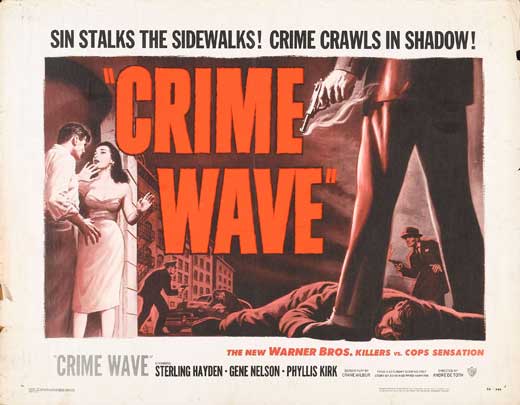
Crime Wave is a classic film noir from 1954 staring Sterling Hayden as a police detective this time instead of the criminal. This film is Directed by André De Toth who made this film under budget and in only 13 days!  The studio scheduled this for a 35 day shot and De Toth said he could do it in 15, he beat that.  The studio wanted Ava Gardner and Humphrey Bogart, but De Toth said he could do this faster and come in under budget if he got to pick the stars.  De Toth wanted Hayden and this is how he got him.

For me Gene Nelson is the center of the story and this was his first dramatic role.  He was more known as a dancer and appeared in a number of musicals.  Phyllis Kirk plays Nelson’s wife and pretty much is just a pretty face in this.  Nelson of course is trying to keep her safe, but Kirk really is hard to read in this role as the sacred housewife.  Timothy Carey has a small uncredited role, but it stood out to me.  The biggest small role goes to Charles Buchinsky who plays one of the thugs that recently escaped prison.  Buchinsky is a scary tough guy with a hard edge to him, he later changed his name to something you may recognize,  Charles Bronson.

Our story starts out with three escaped convicts robbing a gas station.  They get away but one is shot and not doing to well.  Hayden is the lead detective on the case and one of his leads is an old prison cellmate who is trying to get his life on the straight and narrow(played by Nelson).  He is married now and has a good job, but Hayden is suspicious.  Soon the shot escapee shows up at Nelson’s apartment with a veterinarian that is known to work on the occasional injured criminal.  The doctor is too late and the man dies in Nelson’s apartment.    Soon Hayden shows up at the apartment and all hell breaks loose.

This is a very good movie all film noir fans will love.  It is also a great film for Hayden fans as well as Bronson fans who would like to see some of his early work.

Favorite Tidbit:  This movie was an inspiration for part of Quentin Tarantino’s Reservoir Dogs and part of the screenplay is dedicated to director André De Toth.

Review: The Burglar

The Burglar is a film based on a book and screenplay by noir great David Goodis.  Goodis went to Hollywood after the massive success of the movie Dark Passage was based on his novel.  He got flustered with the Hollywood machine and moved to Philadelphia.  Who knew the Philadelphia movie industry would come calling.  When Philadelphia wanted to showcase their city like Los Angles and New York were doing, they looked at one of their own to write a screenplay based on his book.

This movie was actually made in 1955 and shelved.  This was probably more frustration with the movie industry Goodis would feel.  Luckily Producer Louis W. Kellman cast the relatively unknown Jayne Mansfield in a role, this was based on how guys were reacting to her on the set of Pete Kelly’s Blues, where she had a small part.  Kellman was not the only one to see something in Mansfield, movie goers fell in love with her after they saw her in The Girl Can’t Help It in 1956 and her star was on the rise.  This movie was finally released in 1957 because of her new-found star power.

This was also the first film directed by Paul Wendkos who went on to direct many television projects and movies with a very long career.  Columbia bought this film as a favor, but wanted Wendkos as part of the deal.

This film also stars one of noir’s favorite actors, Dan Duryea as our title character.  This film can be argued to have two femme fatales, they both contribute to our hero’s downfall.  Of course we have Mansfield as the girl our hero has vowed to protect and we have Martha Vickers as the girl our hero picks up in a bar, she happens to be working with a crooked cop, out to get our hero.

This story starts out with our hero and his crew robbing a rich women of her priceless necklace.  The burglary is an intense scene, with our hero outsmarting some cops and using his skill to break into a fortress to steal the necklace.  They go back to their hideout to determine the value of the necklace and what the split will be.  This is where we meet Mansfield and soon see she is in danger from an over lusting member of the crew.  Our hero sends her to Atlantic City for her own safety.  Duryea picks up Vickers in a bar and goes back to her house.  While she thinks he is asleep she goes to meet the crooked cop as our hero tails her and he learns they are working him and Mansfield to find the necklace.  Our gang of burglars take off from Philadelphia to Atlantic City to protect Mansfield even though they know this will put them in danger.

This is a good film and the finale on Atlantic City’s Boardwalk with scenes in a circus and carnival settings is very good.  Did Lady of Shanghai inspire this?  Worth watching for all noir fans and especially those of Goodis’ writing.  Goodis didn’t have much luck in America, but he would soon be discovered by the French and elevated to one of the greatest noir writers ever.

Favorite Tidbit:  This was remade in France as The Burglars, the second of a string of movies made over the next three decades in France based on Goodis’ books.