10 Outstanding Neo-Noirs of the 2000’s from Listverse.com

I came across this list last night and found it interesting. It’s a great list of films and all are worth watching, if you haven’t seen all of these films yet, you should add the ones you have missed to your watch list. That is not why I found this list interesting. The reason I found this interesting is Tyler Searle, who wrote the list, shows some interesting parallels of each choice to films from the classic film noir era and explains why he put the movie on the list.

The list was written a few years ago in 2012, so it is missing films that came out after that date. That does not make this list less impressive and is worth reading through. I also noticed that Searle called this 10 Outstanding and not 10 Best, so you may argue he didn’t put your favorite film on this list, but I don’t think you can argue that any of these 10 are not outstanding.

Click on the link below for the full article and list.

http://listverse.com/2012/02/01/10-outstanding-neo-noirs-of-the-2000s/

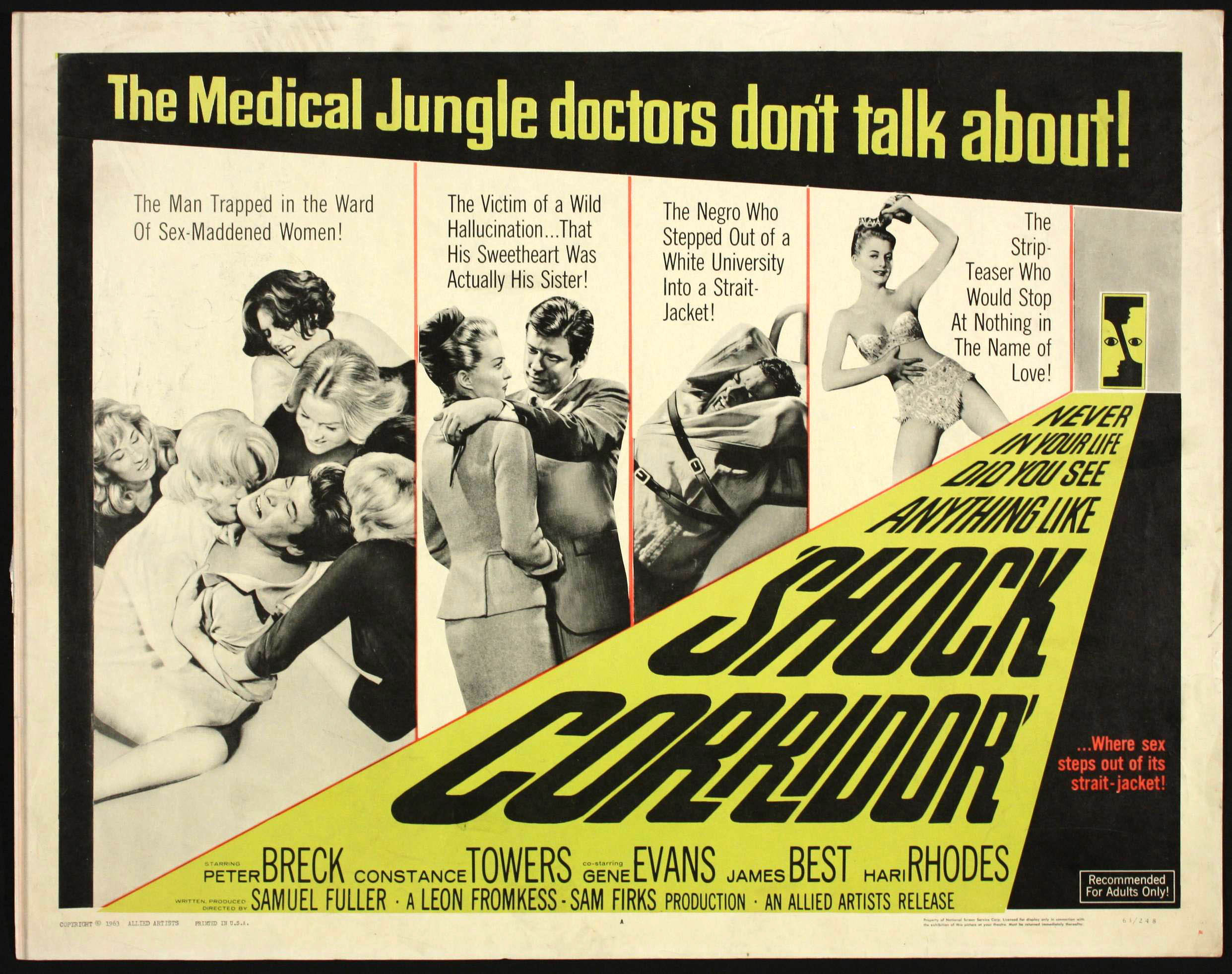
Review: Shock Corridor

So the classic film noir era ended in 1958 according to some film noir historians, some might stretch it to 1960. I guess nobody told Samuel Fuller, because this film is about as close to a classic film noir as you get. This film is written, directed and produced by Fuller in 1963, and Fuller has done it all in the noir genre.

This film stars Peter Breck, who plays a journalist named Johnny, and is willing to do anything to win a Pulitzer. He trains with a psychiatrist to look like a mentally disturbed person when the time is right. He has a girlfriend, played by Constance Towers, who happens to be a stripper with brains and is madly in love with Johnny.

Johnny wants his girlfriend to act like his sister and tell the police that Johnny is making sexual advances towards her. So in 1963, I guess a stripper could tell a cop,” this is her brother and he is abusing me” and that is enough to get thrown in the mental hospital. You would think a background check to see if Johnny is even her brother would be done first? So we got to suspend our disbelief for a bit, but that is OK. So Johnny’s girlfriend thinks this is a really bad idea, I think she maybe right. Johnny wants to get institutionalized so he can solve a murder of a patient in the hospital. He knows there are three witnesses to the crime and one of them has to know who really committed the murder. So Johnny is deemed insane and sent to the hospital and proceeds to get close to the three witnesses as well as some of the other patients and staff members. Will Johnny solve the murder? Will he stay sane? Will his girlfriend stay with him when it is all over?

There are some very good performances in this film, but besides the two leads the one that stood out the most to me was James Best as Stuart. I’ve never really seen Best play anything by Rosco on The Dukes of Hazard, so it was a pleasant surprise to see him in something totally different.

This film is shot in black and white and it also uses a lot of classic film noir techniques for the cinematography.

The story is told with a few voice overs and delves into some dark places of the mind and our society. Finally one of my requirements for being a great film noir, this film doesn’t exactly have a happy ending. So by date alone I will file this under neo noir. On the other hand I think classic film noir lovers will actually really like this film. Forget what date is on it and just enjoy this film for what it is.

Review: Woman on the Run

As Eddie Muller said, this is the best film noir you have never seen. This film went into public domain making it easy to find and see, but the quality has been lost in the over copying. Muller himself was key in finding a few original prints and getting them edited together to make a restored version. He introduced this on the first night of TCM’s Summer of Darkness. This film was made in 1950 and directed by Norman Foster, who also helped with the screenplay, based on a story by Sylvia Tate.

This story is about an artist who witnesses a murder. It turns out the man murdered was a key witness in a case. The artist played by Ross Elliott is now the key witness and only person that can identify the murderer. He runs from the cops knowing his life is in danger. His wife played by our main star, Ann Sheridan is the police’s only lead in finding their new witness. She is crafty and out smarts the police at every turn, getting away from them in the hopes to find her husband before the police find him. Our couple has been married for four years and things are not going well. As the movie goes on she finds new things about her husband that makes her heart grow fonder of her husband. She also realizes her husband really does love her. Along the way she teams up with a journalist played by Dennis O’keefe to help find her husband. He is offering good money for an exclusive interview from her husband and seems to know the city of San Francisco. As our two are on their hunt for the missing witness we get to see a lot of this classic noir city. The hunt continues as our duo continue to try to lose the cops and beat them to her husband, but not everything is as it seems.

,

This film has a grand finale at a Carnival, something I have seen in two other noir films with the first and most famous one being The Lady from Shanghai. We also see an artist getting in over his head, this is also the third time I have seen this theme, with Scarlet Street being the first and best of this idea. Yes, I would put this movie behind these other two on my list of great film noir, but this film would be on the list. I have not seen a lot of films with Ann Sheridan before, but this movie has made me a fan and I will be looking to see more of her movies. If you are a fan of Sheridan or classic film noir, this is a must see. I did see the restored version and have not seen the public domain versions, but from the sound of things, it is worth seeking out the new restored version.

Favorite Tidbit:  Eddie Muller mentioned that he thought Ann Sheridan made a conscious decision not to be objectified in this film, as she was more known for her curves then her acting up to this point. She wore a big coat in almost every scene in this film to cover her body.

Review: The Double Hour or La doppia ora

The Double Hour is an Italian neo noir from 2009 directed by Giuseppe Capotondi. It stars Ksenia Rappoport as our female lead and Filippo Timi as our male lead. This film has a bit of a few genres rapped into one unpredictable film. This is a psychological thriller mostly, horror in parts, a murder mystery in a way, a heist movie to a curtain extent, and a twisted suspense movie to boot.

This story starts out with Sonia, played by Rappoport, working as a maid at a high-end hotel. She soon witnesses a suicide at the hotel. We then find her at a speed dating event, she hits it off with Guido played by Timi. Timi takes a liking to Sonia as well, but goes home with another women. He seems to have a women hating streak as he quickly gets rid of his date after the deed is done and seems to be a bit upset after she leaves. We then see our couple get together and go out on a date, where we learn Guido used to be a cop. We then find our couple out in the country enjoying an empty mansion. Guido works security for the home and has set up the alarm system as well. Our couple is enjoying the outdoors when a masked man hits Guido over the head with his gun. We find the couple tied up in the mansion as a team of thieves steals all the antiques and art work. They seem professional and are in and out fairly fast as they package the valuables into two moving trucks. One of the masked men comes back in and makes a move on Sonia. Guido with his hands still tied up, jumps on the thief and there is a struggle over the masked man’s gun. A gunshot goes off and the screen goes black! The story twists and turns from here with a lot of unexpected revelations.

Here is another very good film that is getting the American re-make treatment. This time Michelle Williams and Joel Edgerton are set to star as our two leads.

We will see how the remake will stack up, but for now I recommend seeking out the original. If you are a fan of the mysterious, and films that make you think and that you want to see twice to see what you missed the first time, this is the film for you.

Review: Stranger on the Third Floor

Stranger on the Third Floor is a film Boris Ingster who sadly only directed three films. After seeing this film I would like to see more from him. This film is written by Frank Partos who has written many classics for the silver screen. This film’s biggest star is Peter Lorre, who made this film with only a few days left on his RKO contract. His role and presence doesn’t have much screen time, but he still got top billing for his appearance in this film.

So for many classic film noir historians, The Maltese Falcon is the first true film noir. This film actually came out the year before Falcon and as some have said, this is actually the first true film noir. As everything with noir, people have varying opinions. This film checks almost every box a film noir should as far as style and story. We have amazing cinematography with lots of shadows and low angles. We have a characters wrongly accused of crimes they did not commit and seemingly no way out. The story is intense with some of our characters having few allies to turn to. The ending isn’t exactly happy, well if it would have ended about 5 minutes earlier anyway. The story is told with flashbacks and has a crazy dream scene which uses a lot of noir techniques. You will get Claustrophobia feelings as our protagonist’s world comes down around him. The only fault I can see for this not being the first true film noir is we do not have a femme fatale of any sort. Personally I would say this is a film noir, so let the arguments for and against this begin.

If this film still doesn’t say classic film noir, I don’t know what does.

John McGuire plays a journalist who just got a raise and wants to marry his girlfriend played by Margaret Tallichet. Everything is going great for our couple. The reason he is getting his raise is he has written an article about a murder, which he happens to be the only witness to. The story goes into the court room where Elisha Cook Jr. is the accused murderer and everybody from the lawyers and judges, even the jury is phoning this one in. They find him guilty of the murder of the coffee shop owner and he goes to death row. Tallichet goes to court to watch her boyfriend in action. She feels that Cook Jr. could be innocent and McGuire’s testimony put him in prison. This gets McGuire thinking she maybe right. He goes home where he sees the stranger on the third floor played by Lorre. He chases Lorre out of the building, but feels there is something wrong in the apartment next door. The neighbor and McGuire have butted heads before and he realizes how easy it would be, to be framed for his murder. As our story continues we ask questions like, Could the neighbor really be murdered? Will he be framed for it? Is Cook Jr. innocent after all?

This film is very good and worth watching whether you think it is a film noir or not. That just makes the conversations about this film more interesting. Our four big stars are all great in this, with Lorre and Cook Jr. at their creepiest best. I also found Tallichet a very gifted actress, it is a shame she retired from the business so early in her career. If you love classic film, noir or not, you will like this film.

Re-Watching: Deadfall

Deadfall is a neo-noir from director Stefan Ruzowitzky and written by Zach Dean, but the real story here is the amazing cast! We have Eric Bana as a casino robber with a violent streak. Olivia Wilde as Bana’s little sister and has a bit of a strange relationship with her brother. Charlie Hunnam is a man recently released from prison for fixing a fight and happened to win the silver medal in the Olympics. Kate Mara plays a police officer with F.B.I. ambitions. We also get veteran actors Treat Williams as Mara’s father and the local sheriff and Kris Kristofferson and Sissy Spacek as the farming parents of Hunnam.

This story starts out like a car crash, literally! Bana and Wilde are counting money while they are being driven in a limo. The limo hits a deer on a snow-covered road and goes rolling down a bank. The police officer responds and Bana kills him. Bana and Wilde split up in this winter wonderland as the police are unaware of Wilde’s involvement in a casino robbery. Bana goes on a wild winter survival adventure across the frozen land. Hunnam, who was just released from prison, goes to his boxing manager’s gym, as he was the one that had him throw a fight. this is what caused him to go to prison. The two get in a fight and the manager ends up dead. Hunnam is on the run, he does not want to go back to jail. He heads to his parents for Thanksgiving and on the way picks up an almost frozen Wilde. The story builds to a violent and unhappy ending.

The selling point of this film in my opinion is the great cast. Though Spacek and Kristofferson do not have big roles and this shows nothing new from them, they are still great as an All-American couple. Wilde is very good as our femme fatale with second thoughts. Hunnam plays a every man with bad luck very well. Bana plays a psychopath, but doesn’t go over the top with his performance. The story is complex and comes together fairly well, making it interesting. I will say there is something a bit off about this film. but I can not put my finger on it. This is an average film that is missing something that could have made it a great film. Neo-noir fans will find it an enjoyable watch, and if you are a fan of some of the cast it will be worth your time.

Review: I Was a Communist for the F.B.I.

I Was a Communist for the F.B.I. is a film noir from 1951. This story is based on Matt Cvetic who was an undercover informant for the F.B.I.. Gordon Douglas directs this movie in a docudrama format. I am not a big fan of the docudrama format for noir and still have not seen one that I love.

Frank Lovejoy plays Cvetic in this film with Dorothy Hart playing a teacher and member of the Communist Party.  Cvetic is undercover in Pittsburgh where the Communist Party is trying to disrupt manufacturing. He is suspicious of everybody as he doesn’t always know who is with him and who is against him. This does show him in his family life where his son has a hard time defending him at school and his brother fights with him constantly because he thinks he is a Communist. This part of the story felt pretty real to me. On the other hand, the members of the Communist Party who are portrayed in this film seem to over the top. They are very racist, having issue with Jews as well as Blacks. They seem more like the mob, as they don’t care who gets hurt and use a lot of violence to get their message across. This film is obviously a propaganda film for Anti-Communism and though it maybe based on a true story they definitely made sure the members of the Communist Party had absolutely no redeeming qualities in this film. This film is short and to the point. If we ignore the politics of this film it is a decent noir with some great suspenseful moments. On the other hand it is fun to look at the politics of this film as a time capsule to see just how paranoid of the communist movement America was in the 1950’s, maybe all the way through the 1980’s for that matter.

This is an interesting film. I would not say it is a great film by no means, but can be viewed in a number of different and entertaining ways. It has a different feel to it then most classic film noir, and though our main character is on the verge of being found out at every turn, it isn’t as gritty as most. This is worth viewing for film noir buffs, but if you are new to the genre, I would recommend starting somewhere else. I would also like to hear from you political historians out there and what you felt about the film in that context.

Favorite Tidbit:  Though the Communist Party was fairly large at one time, with reports of up to 200,000 members, by the mid 1950’s the number of members was under 10,000 and 1500 of those where undercover F.B.I. informants.

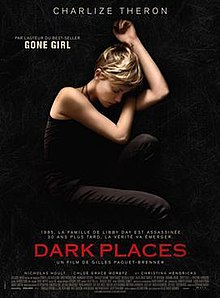
Movie Trailer: Dark Places

Dark Places may not have the commentary on society like Gone Girl, but Dark Places is still my favorite Gillian Flynn book so far, and I think the darkest. I’ve been looking forward to this movie ever since I finished reading the book. Based and the trailer, it looks like they did a good job with it.  This is a great cast and the look of the film feels very noir. Who else is excited to see this one?

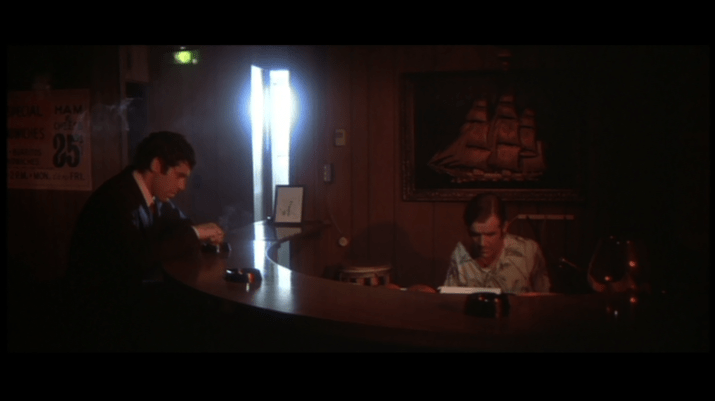
Review: The Long Goodbye

The Long Goodbye is a neo noir from Robert Altman made in 1973. This is based on Raymond Chandler’s masterpiece book of the same name. I have read 3 of Chandler’s books but have not read this one yet. When this was released in Los Angeles it was a big failure and Chandler fans were horrified by this adaptation. The marketing was changed to show it as more of a satire of Chandler’s work in New York and the film had a little more success. Though it had more success on the east coast it was still a big flop at the box office.  Robert Altman took a lot of chances with this film. He took a beloved book and moved its setting from 1950 Hollywood to 1972 Hollywood. He also took a new ending from the script by Leigh Brackett(who also wrote the script for The Big Sleep in 1946) and fought to keep it, instead of staying true to the original novel. He also hired Elliott Gould, who was black listed for being hard to work with and had not worked for 2 years at this point.

So this film had a lot going against it and it was not a big hit, so how come it is considered such a classic today among noir and neo-noir fans? Chandler’s Phillip Marlowe appeared in 4 film in 10 years with Marlowe in 1969, then this film and then two more films a few years later starring noir legend Robert Mitchum in a more true to the books adaptations. I have seen all three of those and they are all good, but this adaptation is the one that gets all the attention. I have to agree that it is well deserved. It is different and a much more enjoyable watching experience then the other three films.

Elliott Gould’s Marlowe is a quick tongued private detective, but does not use the wit as Chandler wrote it. He ad-libbed a lot of his dialog making it seem more fresh and less rehearsed then other adaptations. We also have Sterling Hayden playing a crazed writer. Hayden said this is one of his favorite films. Nina van Pallandt plays Hayden’s wife who hires Marlowe to find her husband. We also see Arnold Schwarzenegger in an early appearance in his career as a body-guard who says nothing, he also went uncredited for this film.

This film starts with Marlowe being called in the middle of the night by a good friend. He asks Marlowe to take him to Mexico right away. Marlowe does, and doesn’t ask many questions. Marlowe ends up getting taken into custody for questioning. His friend is accused of killing his wife. They hold him for 3 days and then he is suddenly released.  He soon finds his friend has committed suicide in Mexico and the case is closed. Soon Marlowe is assaulted by some baddies and they want their money back. Marlowe of course doesn’t know anything about any missing money.  He thinks his friend was murdered and did not commit suicide and starts looking into it. He is soon hired by a woman to find her husband.  This couple is neighbors to his now dead friend. Are both cases related? Will he find who killed his friend and his friend’s wife?  Will he find the missing money?

This is a twisted and hard to follow story that does not serve up easy clues and often doesn’t make sense, but what would you expect from a Chandler story? It is a fun watch and something you can re-watch over and over again. Is it the best Chandler adaptation? My favorite is still The Big Sleep with Bogart, but for a lot of people this is their favorite.  If you are a noir fan, and if you are, you are probably a Chandler fan too, you need to check out this film.
Favorite Tidbit: Thought this is moved from the 1950’s to the 1970’s, Marlowe still drives a car built-in the late 40’s and his pay is $50 a day plus expenses, an amount more in line with pay from the 50’s then the 70’s.
Review: Crime of Passion

Crime of Passion is a film noir from 1957 with 3 of noir’s greatest.  We Have Barbara Stanwyck, Sterling Hayden and Raymond Burr in a love triangle that can not end well. Gerd Oswald directs this film, written by Jo Eisinger.

This story starts out with Stanwyck working at a paper as an advice columnist for a San Francisco paper. She gets put on a story against her will where she meets a couple Los Angeles cops who fly up about the case. One of the cops is Hayden and Stanwyck falls in love in short time. She soon moves down to Los Angeles and marries Hayden. She has problems getting along with the other cop’s wives and doesn’t handle the stress of being a cop’s wife herself. We soon learn that Hayden’s boss is Burr and an old flame of Stanwyck’s. Burr is also married, his wife is played by none other than Fay Wray. Wray is very sick and this is hard on Burr. Soon Burr and Stanwyck start seeing each other again. This love triangle does not end well and our story really heats up.

This film is short and starts out quit slow, but it heats up in the last half hour. The film plays as a bit of a psychological thriller and Stanwyck is getting the ball rolling on the psychotic femme fatale that we would see in future films like Fatal Attraction.

Hayden is very good playing his every man’s man, as he always does. Burr is real good playing somebody with a lot of power and is very strong, but when he lets his guard down and shows some weakness it is very believable. Stanwyck is good as always and you could watch this again just to get all the little nuances of her performance. Wray plays a smaller part, but does a good job with it.

This is a good film and well worth watching. Just give it some time to get started as the first half of the film is a little dull and slow. It quickly builds to an interesting noir by the end.