Review: Inferno

Inferno is a 3D film-noir!??!  This movie is filmed in 3D, a very popular thing in the early 50’s and 20th Century Fox was a little late to the game.  This was their first film in 3D and didn’t come out until 1953.

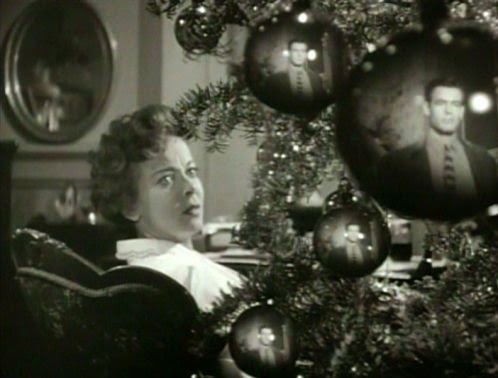
This has film noir great Robert Ryan playing a millionaire that is abandon in the desert and left for dead.  He has a broken leg and has to survive on his own with very little water and food.

We also have frequent femme fatale Rhonda Fleming as the wife that leaves her rich husband in the desert to die.  Her motivation for doing so, is falling in love with the desert guide 3 days before, played by William Lundigan, and a circumstance where her husband falls from his horse and breaks his leg.

This is written by Francis M. Cockrell who wrote a lot of crime and thriller stories for the big and small screen.  Inferno is directed by Roy Ward Baker who directed many crime and horror projects for movies and television.

Our hero’s thirst for survival is based on his need for revenge on his wife.  We almost have 2 films here, the survival story of our hero and out femme fatale covering up the murder she thinks she’s committed.  Both come back together for a final conclusion in the end.

This is not a traditional film-noir, being filmed in color and 3-D, with stereo sound to boot.  The effect is well done, with the beauty of the desert setting and Fleming’s red hair and blue eyes popping in vivid Technicolor.  I watched this on television so I didn’t get to watch this in 3-D.  There was a few of these 3-D noir films made in the 1950’s, it would be cool to see these released on 3-D Blu-Ray.

This is not a widely viewed film with under 600 viewer ratings on IMDb.  I actually think this would be enjoyed by a wider audience then just crime and noir fans.  I think the outdoors enthusiast as well as western fans may enjoy this as well.
Review: Beware, My Lovely

19096407_1_l

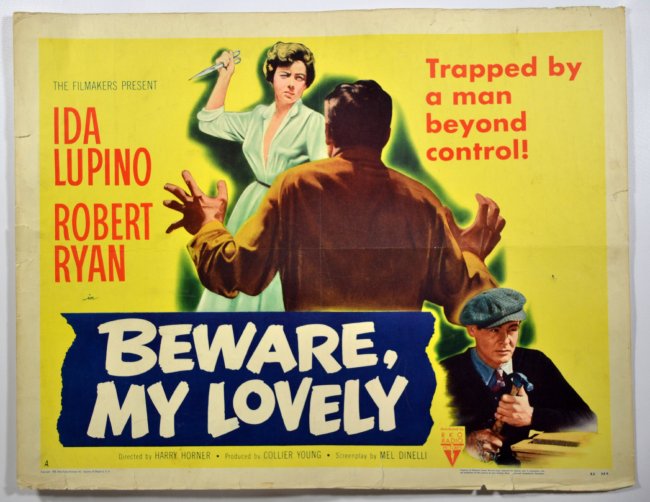
Beware, My Lovely is based on a play, based on a short story that is written for the screen by Mel Dinelli.  Dinelli was a writer on many film noir and thrillers through his career.  It is directed by Harry Horner who also directed Vicki, a film noir I plan on watching and reviewing on this site at a later date.

Of course the attraction to this film is its two leads, both film noir legends.  Ida Lupino not only starred in many film noir movies, she also wrote, directed and produced.  Something not to common for a female in the 40’s and 50’s.  Lupino is an under rated talent in the history of Hollywood and more people should know about her.   Robert Ryan known to play an intimidating tough guy in film noir, war and western movies.  In real life he had the make up of a hard man, at 6’4” and a World War II vet with boxing experience, you can see why he was perfect for a lot of the roles he played.  Though these traits got him a lot of tough guy roles, he was a pacifist in real life.

This film opens with Ryan cleaning a house, when he opens a door and sees a dead women on the floor.  He takes off on the run and ends up at Lupino’s house, hired as a handy man.  Ryan’s character is a dangerous schizophrenic that imprisons Lupino in her own home.

This is a very claustrophobic film, with a cat and mouse element.  Not sure if this is the first film of its kind but has to be an influence on future works like Misery, The Panic Room,and especially Funny Games.  This had to influence in some ways many horror movies as well.  This shot is one of the coolest shots I’ve ever seen:

BewareMyLovelyOrnament

This is slow-moving pot boiler that gets hotter and hotter as it goes.  If you’re a fan of Lupino or Ryan you need to check it out.  This is not a widely viewed film with less than 1,000 user votes on IMDb, and should be viewed more, especially by film noir, thriller and even horror fans.

Review: Crack-Up

Crack-Up-Poster-web3

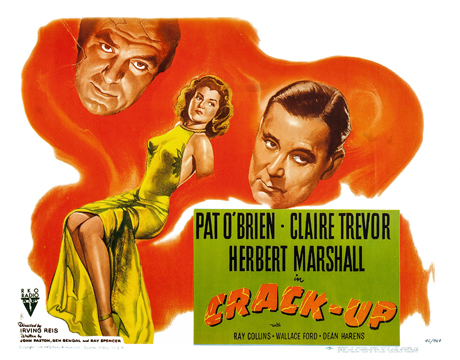
Crack-Up is a film noir from 1946 staring Pat O’Brien!

6a00d834fd7f7353ef01156fd10702970b

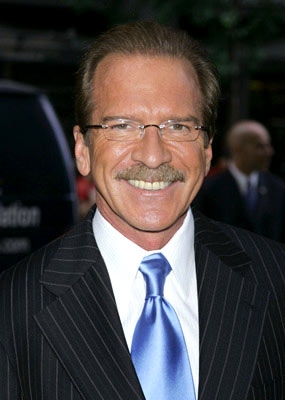
No, Not that one, this one:

O'Brien, Pat_01

Crack-Up is based on a short story from Fredric Brown and is directed by Irving Reis.  Our leading lady is played by Claire Trevor.  Trevor appeared in many film noir threw out her career.  Character actor Wallace Ford plays our lead detective.

The story starts out with our hero breaking into a museum and looks to be drunk and out of control.  He is followed in by a police officer who wants to arrest him for public drunkenness and for trying to take a swing at him.  The board for the museum is having a meeting at this time and recognize our hero and ask if the police officer will let them take care of him.  He isn’t drunk he is sick.  Our hero comes to and tells our detective how the last thing he remembers is being on a train when it wrecked with another train.  The only problem is there was no train wreck!  This is where the mystery takes off.  Why does he think there was a train wreck? What happened to our hero? Was he drugged? This mystery is just the beginning, as we have murder, art, money, dames, conspiracies and a twisting plot that will leave you swinging in the wind.

Another great looking film noir, this one by camera man Robert De Grasse.  The story sometimes doesn’t make a lot of sense and may have some holes in it that are hard to overlook.  I really thought this movie might have a mentally ill main character, given the name of the film and the way he acts at first.  I guess in 1947 the public wasn’t ready for mentally ill main characters. As the movie goes along we find a perfectly good reason for the way our hero is acting.  Then it is made light of with our last line, “Everybody is nuts around here, but me.”

This is not a widely watched film with a 6.6 rating on IMDb from only 657 voters.  I would say this is a far rating and is worth watching for the hard-core film noir fan, but not a film I would recommend for somebody that is looking for just a few good examples of the genre.

Review: T-Men

Tmen

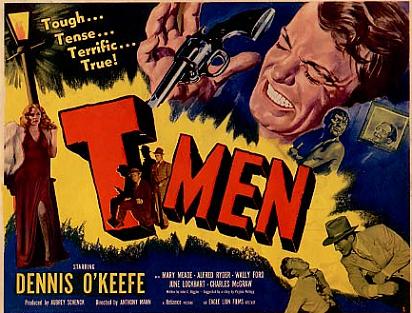
T-Men is a B-movie film noir from 1947.  It’s told in a documentary-drama style story.  This movie is directed by Anthony Mann and showcased his talent.  It is filmed in a low light, classic film noir style that looks amazing.  Mann directed a few more film noir B movies and then moved on to westerns and eventually full on Hollywood historic epics.  Even though T-Men was a fairly low-budget film it got nominated for an Academy Award for Sound.  The movie was written by John C. Higgins and Virginia Kellogg both of which wrote many crime films in their career.

Dennis O’Keefe plays our main hero and undercover T-man.  He definitely had a good presence is this role and did many B-movies including a few more film-noirs, he also did a lot of television work, including having his own show for a while.   Wallace Ford plays The Schemer and that describes the character well.  He is always looking for an angle and scheming for his next score. Ford played the most interesting character in the film, in my opinion.  Alfred Ryder plays O’Keefe’s undercover partner and comes across as an average every-man that may be in over his head.

I could not find anything about the story behind this movie.  It plays as a true case from the Secret Service, but I can not find if it really is.  Anybody out there shed some light on this?  If these bad guys were real, they where both incredibly brutal and smart.

This story is about two T-men or I.R.S. Agents sent undercover to break up a counterfeit ring.  The ring seems to be based in Los Angles, but anytime anybody gets close to the root of the group it leads to a dead-end.  They trace some counterfeit stamps in Detroit that are from the same group.  Are hero’s are sent to Detroit to infiltrate the ring from there.  This is where are adventure takes off.

This movie isn’t the most interesting story or have many twists and turns to it, but if it is a true story that would make sense.  I would not put this noir in my top ten, but it is worth viewing for hardcore film noir fans.

t-men-1947

Review: The Man with the Golden Arm

full.themanwiththegoldenarm-1sh-20585__44788.1407792251.1280.1280

The question I had before viewing this film was “Is this a film-noir or not?”  I have no degree in film, and this doesn’t have the traditional technical aspects of a true film noir, and from what research I can find, Otto Preminger didn’t want this to be a traditional film noir. Preminger was a director that knew noir, he made quite a few, some before and some after this one. So could this be the very first neo-noir?  All I know is this is filmed in black and white and doesn’t have as much shadow play as most films of this era.  The subject matter on the other hand is very noir, it is gritty and dark.  The movie is based on the book of the same name written by Nelson Algren.

We have a convict fresh out of prison.  He was arrested as a card dealer at an illegal casino and he has a drug problem.  He comes out of prison, clean and with a new skill as a drummer.  He is looking for a fresh start, but gets pulled into his old ways.  His girl is bound to a wheel chair because of a spinal issue, she needs money to go to the doctors to help her find a cure.  She is about as close to a femme fatale as you can get.  There is also the beautiful neighbor down stairs who is the girl our hero really likes.  We have an old boss that wants to control our hero and get him back into dealing cards for him.  We got his best friend that is an honest hustler, he feels he is more honest than the criminals around him, but still a criminal.  Murder, drugs, gambling, dancing-girls, hustlers, thugs and love triangles, sounds like noir to me.

The film also pushed the boundaries of The Motion Picture Association of America’s film code and is one of the reasons the code was changed.  Because of its drug use in this film it almost wasn’t approved.  After this film, taboo subjects like drugs, kidnapping, abortion and prostitution were allowed in film.  This would of course be big for noir and neo-noir films to come.

This was nominated for 3 Academy Awards including Frank Sinatra’s one and only nomination for his portrayal of Frankie Machine.  Eleanor Parker plays Frankie’s wheel chair bound girlfriend.  Kim Novak plays their neighbor, Molly. Funny man Arnold Stang plays Frankie’s side kick Sparrow.  Darren McGavin plays the underworld boss that is trying to control Frankie.

So for those fans that have seen it, what do you think?  Is it a film-noir or a well done crime drama?  In either case it is a good film worth watching.

Review: The Blue Dahlia

the_blue_dahlia

So did anybody write better classic noir dialog than Raymond Chandler?  I don’t think so, his wise cracking P.I. Phillip Marlowe will always be one of the greatest fictional character of not only noir, but all of fiction.  Though we don’t have Marlowe in The Blue Dahlia, we are not missing on the crackling dialog.

Clean sheets every day they tell me.  How often do they change the fleas?

Seems I’ve lost my manners or would anyone here know the difference?

Joyce Harwood: Well, don’t you even say ‘Good night’?
Johnny Morrison: It’s good-bye, and it’s tough to say good-bye.
Joyce Harwood: Why is it? You’ve never seen me before tonight.
Johnny Morrison: Every guy’s seen you before somewhere. The trick is to find you.

You’ve got the wrong lipstick on, Mister.

‘Dad’ Newell: [examining Helen’s body] Been dead for hours.
Mr. Hughes, assistant hotel manager: Suicide?
‘Dad’ Newell: Could be.
Mr. Hughes, assistant hotel manager: Better be!
‘Dad’ Newell: Unh-unh! Too much gun!

I know I’ve got lots of faults, but being in love with you isn’t one of them, is it?

These are some of my favorite quotes from this film, and if it was just the dialog this would be a 4 out of 5 star film.  But Raymond Chandler doesn’t just write great dialog, he can put together a pretty good plot too.  This has three friends coming back from the war. Our hero is played by Alan Ladd, who goes to see his wife.  She is having a party and he soon finds out that she has a new beau.  The new boyfriend played by Howard Da Silva, owns the night club “The Blue Dahlia” for which the movie is named.  Soon our hero’s wife played wonderfully by Doris Dowling, she is just the right amount of evil that we can see why our hero wants free of her, but also the right amount of sadness that we feel sorry for her having to be by herself while her husband was at war.  She’s mad, but we understand why.  She is found dead and we don’t know if it’s suicide or murder.  The police start with the most likely suspects, which includes our hero.  Now he has to find the killer before he takes the fall for murder.  Along the way we have William Bendix playing Buzz.  Buzz is a great character who has some brain damage from the war, does he also have post-traumatic stress syndrome before we really knew what it was?    Then of course we have Veronica Lake who plays the night club owners wife.  I would call her the femme fatale of this film, but she doesn’t try to decisive anybody, or use anybody, or try to get away with anything, she’s actually a truly good person.

Raymond Chandler had to change his original ending and was not happy about this.  I will not tell you why or how it is changed here, because it is a spoiler and we don’t believe in that here, but after you watch it you can probably see what is changed and maybe even why given the time frame of when the film was made.

A couple of historic trivia bits for you.

1.  Alan Ladd and Veronica Lake appeared in a number of movies together and rumors started that they where having an affair.  Both always denied this, and it is not known if the rumors where true or not.

2. Elizabeth Short got her nickname The Black Dahlia from this film.  She embraced her new nickname and took to wearing a black dahlia flower in her hair.  She died less than a year after this.  She became the subject of the classic James Ellroy book and not-so classic film, “The Black Dahlia” and part of Los Angeles lore forever.

I really liked this film for its sharp dialog and surprising twists and turns.  A classic noir that all fans should see.

lCqeiqvalqgdeBC1LTWVzsJTERj

Re-watching the Classics: The Maltese Falcon

el_halcon_maltes_1941_3

The Maltese Falcon has a lot of firsts, firsts that would change film, film-noir, fiction and popular culture forever.  The Maltese Falcon is considered by some as the first true film-noir movie.  It is the first movie John Huston ever directed who went on to direct 46 more movies, many of them considered classics and he is considered one of the best directors in history.  This is Sydney Greenstreet’s first film, at 62 years old, he was a stage actor for 40 years before this film.  Greenstreet went on to make 24 more movies in his career, 9 more with co-star Peter Lorre.  This book on which it is based is written by Dashiell Hammett, who some consider the first writer of noir fiction, if he isn’t he certainly is one of the earliest influential writers and a master of the genre.  His work has not only influenced the noir genre greatly, but has popped up in western and samurai movies and films from all over the globe.  I read the book many years ago, and may re-read it and give it, its own review later.  I can tell you that the book is amazing as well.

The Maltese Falcon (1)

This movie has one glaring non-first, this is the third time this book has been adapted to the screen, the other two where rather lack luster attempts(I have not seen either of them).  The reason this one worked so well is John Huston wrote the script just as the book was written.  The previous attempts all had a happy ending, Huston left the original book ending in his version.

The Falcon itself may be the most famous MacGuffin in film history, it is definitely the most valuable.  There are 4 know Falcons and 2 are made of lead.  These lead versions have gone to auction and sold for well over a million dollars.  That is 3x what the original film cost to make.

We have a bunch of the common themes we will find in noir movies for the next 20 years to even today’s neo noir films.  We have the hardboiled private detective with the overcoat and fedora hat, has anybody done this better than Humphrey Bogart?  We have the femme fatale in Mary Astor.  We have an unhappy ending that maybe not what the audience wanted. We have twists and turns, sometimes us as a viewer are not sure what is going on, does our hero know what is going on?  Most of the film is from our hero’s prospective, we are learning as our hero learns. We also have some underling moral issues that are there but not spoken, do to the movie code of the time.  Is our hero having an affair with his partners wife?  Is one of our thugs actually a gay man?  Is our femme fatale using sex and lies to get what she wants?

Our story starts at Spade and Archer’s office.  Spade and Archer are partners and private detectives.  They take on a case where a man needs to be followed because he has taken our clients younger sister and will not let them see her.  When Archer is on the job, he is shot and killed.  This is where are hero Sam Spade takes over trying to find out who killed his partner and why.  Our adventure is with Spade, he is in every scene of this film, except the scene where his partner is murdered.  We don’t know who to believe and who to trust, just like Sam Spade.  If you haven’t seen The Maltese Falcon yet, do it right now!

maltesefalcon3

In film noir and noir fiction for that matter we have two writers, that are considered the best of the era.  Raymond Chandler and Dashiell Hammett.  The debt about who is best will live forever.  I’ve read both of them and can’t pick a winner myself.  I think the winner is us, as readers of this classic fiction.  One thing they have in common is Humphrey Bogart, the iconic star that played both Hammett’s Sam Spade and Chandler’s Marlowe.  Who is your favorite Bogie detective, Spade or Marlowe?