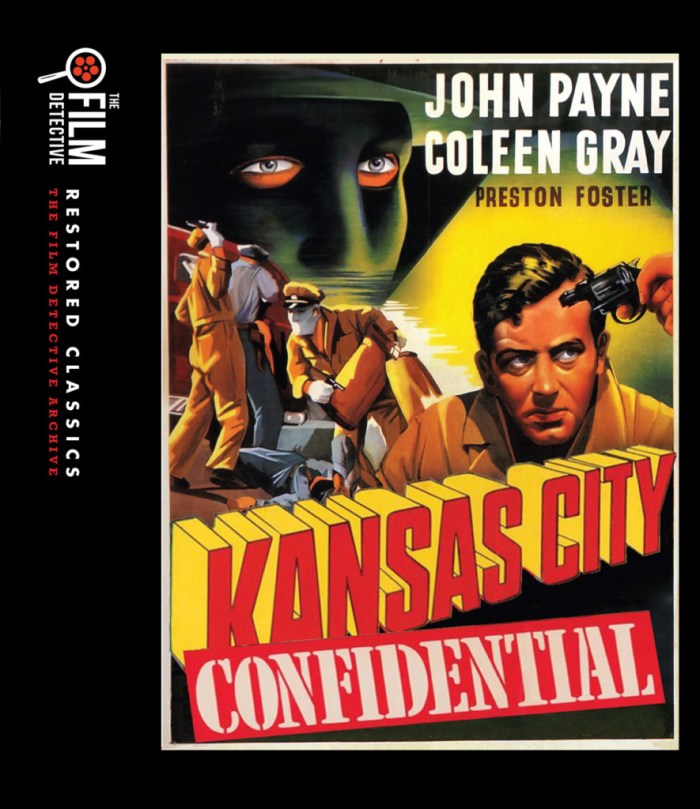
Kansas City Confidential is coming to bu-ray! Read the full article here:
Here is Everythingnoir.com’s review of the film:
https://everythingnoir.com/2015/08/21/review-kansas-city-confidential/
Kansas City Confidential is coming to bu-ray! Read the full article here:
Here is Everythingnoir.com’s review of the film:
https://everythingnoir.com/2015/08/21/review-kansas-city-confidential/

The Crimson Kimono is a classic film noir from writer and director Samuel Fuller. Fuller is an interesting artist that tackled some interesting topics and pushed the boundaries with his films and this one is no different.
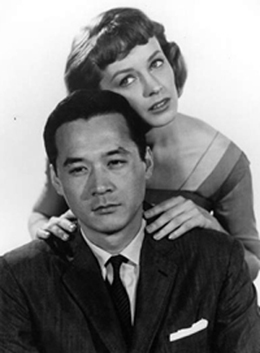
Glen Corbett and James Shigeta play police detectives. Not only are these two partners, but also best friends. They even live in the same apartment and have fought side by side in the war. Corbett plays white detective Charlie Bancroft while Shigeta is Japanese detective Joe Kojaku. This film was released in 1959 and I don’t know if this is the first buddy cop film with a white police officer and a minority partner, but it has to be one of the earliest.
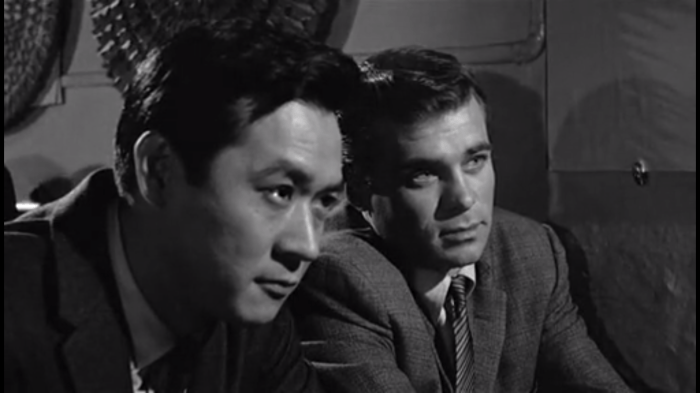
This film starts out with a stripper being shot and killed in the street. When a painting of the stripper in her dressing room is also shot and the only lead to the case, our two detectives track down the artist. Victoria Shaw plays Chris, the artist of the painting. When both of our detectives fall in love with the lovely Chris and Chris falls in love with Joe Kojaku, the drama starts. Will our heroes be distracted by Chris? Will they solve the murder?

Fuller dives into the Japanese culture in this film with a lot of Japanese martial arts being highlighted as well as a Japanese community parade. The big topic this film tackles is a biracial relationship. I liked how the criminal motives and Joe’s inner struggles parallel each other. The pull of love over friendship as well as Joe trying to figure out what is right and what is wrong for him and those he cares about is well portrayed.
Fuller was a pioneer in many ways in this film, taking themes and subject matter like martial arts, minority cultures and interracial relationships and using them in a story line. Common themes we almost expect in films today, but in 1959 this had to be new to the audience.
I like this film overall, but felt the love triangle was rushed or forced at first. This could be because of editing or budget and time constraints on the film. An interesting film for those looking for for something unique to watch and fans of Fuller.

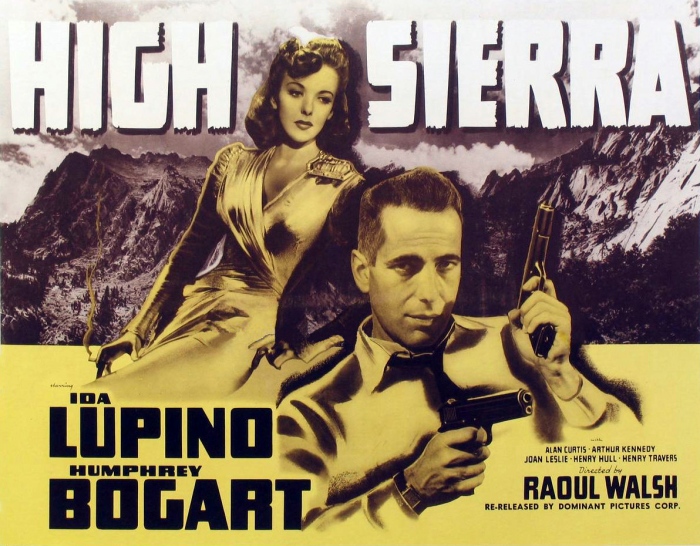
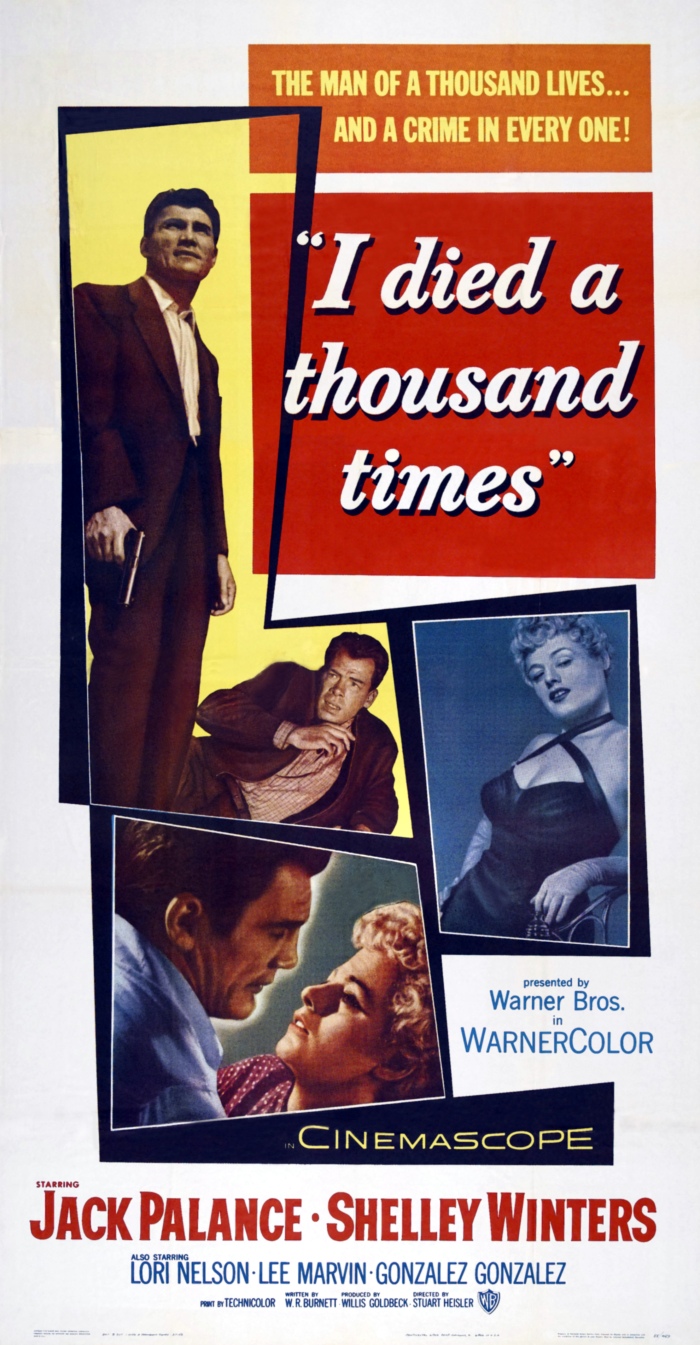
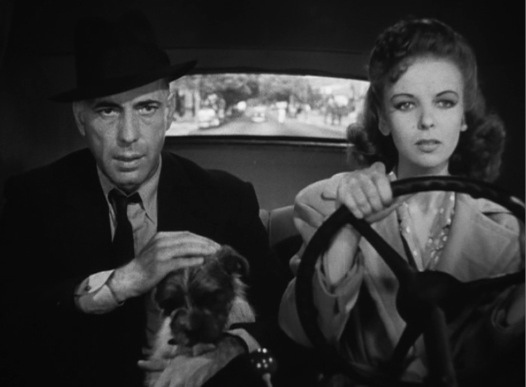
Classic film noir fans didn’t see to many remakes of a film, with both being made during the classic film noir era. Here is a rare example of just that, High Sierra from 1941 was remade 14 years later as I Died a Thousand Times. So what film is the better movie? I sat down on a Sunday afternoon and watched both of these films back to back to try and answer that question.
Both of these films are based on noir author W.R. Burnett’s book, High Sierra from 1941.

Round 1: Screen play
The screenplay is also by W.R. Burnett, though he had John Huston’s help with High Sierra. The dialog is about 85% identical and the story is about 95% identical. It isn’t quite a frame for frame re-make, but it is close. I would call this a wash, but since the remake basically does not add anything to the original, I’m giving this round to High Sierra. Score: High Sierra 1-I Died a Thousand Times 0
Round 2: Direction and Cinematography
High Sierra is directed by Raoul Walsh coming off of directing They Drive by Night. I Died a Thousand Times is directed by Stuart Heisler towards the end of his film career as he moved on to television. High Sierra is filmed in black and white while I Died was filmed in Warner Color and CinemaScope. I know, “this is film noir so black and white has to win this battle.” I would say yes to this question most of the time. Black and white cityscapes are the back bone of film noir after all, but this film is more of a country noir, taking place in the beautiful Sierra Mountains for most of the film. Those mountains sure do look better in bright color and on a widescreen. High Sierra is early in the film noir cycle and doesn’t have much of that classic shadowy cinematography like later films either. So I’m giving this round to I Died. High Sierra 1-I Died a Thousand Times 1

Round 3: The Male Lead
I Died stars the hulking brute Jack Palance as Roy. He is quite a presence on the screen. He looks big and tough and talks big and tough. He is more of a smart thug. Humphrey Bogart’s star is on the rise here, The Maltese Falcon would arrive later in 1941 and launch him into super stardom. Bogart’s portrayal is more of a smart gangster with a bit of a psycho streak. Both actors have an unique voice and add something to the lines they speak. Well, lets face it, this is film noir and nobody does it better then Bogart. High Sierra 2-I Died a Thousand Times 1

Round 4: Female Lead
Ida Lupino actually got top billing over Bogart in High Sierra. She was the bigger star at this point in time. Lupino is a film noir legend as an actress and director. I love everything I’ve seen involving Lupino so far. Shelley Winters stars in I Died and adds quite a bit more depth to this character for me. Lupino’s Marie has it together, while Winters’ Marie is trying to survive in a dark world without many options. Winters’ Marie made me believe Roy was her last hope, where I felt Lupino would land on her feet if she lost Roy. Though I loved them both, I’m giving this round to Winters. High Sierra 2- I Died a Thousand Times 2

Round 5: Supporting Cast
Arthur Kennedy and Alan Curtis are very good as Red and Babe, but Earl Holliman and Lee Marvin seem to be more dark for me. I also liked Lon Chaney Jr. as Big Mac in I Died, but liked Henry Hull as ‘Doc’ Banton in High Sierra. The dogs are both entertaining as Pard. I’m going with I Died for this round. High Sierra 2- I Died a Thousand Times 3

Well it looks like the remake wins this round by round battle, but lets face it, there was actually a knock out in Round 3 and the fight was called. It’s Bogart after all! Both of these films are great, but High Sierra is a classic for a reason. Though if you have not seen I Died a Thousand Times, you should, it is a bit of a hidden gem from the classic film noir era. I enjoyed both films and if High Sierra was never made, we would be talking about the great classic I Died a Thousand Times. Lets face it, High Sierra is a film that never needed a remake, but if you have to make one, I Died a Thousand Times is as good a remake as you are going to find. Maybe on a Sunday afternoon you will have to watch this double feature and let me know your thoughts.
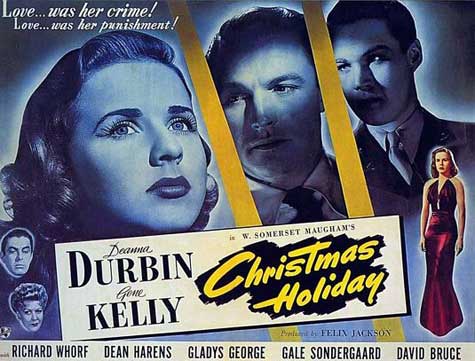
Jake Hinkson has put together a list of films, noir lovers will enjoy over the Christmas Season. So if you are looking for something a little darker then the Christmas Musicals and Comedies that will be all over this season, take a look at this list for some options.
http://www.criminalelement.com/blogs/2014/12/dark-christmas-7-noir-holiday-films-jake-hinkson
Did Hinkson miss any? Kiss Kiss Bang Bang is one of my favorites not on this list, what are yours?
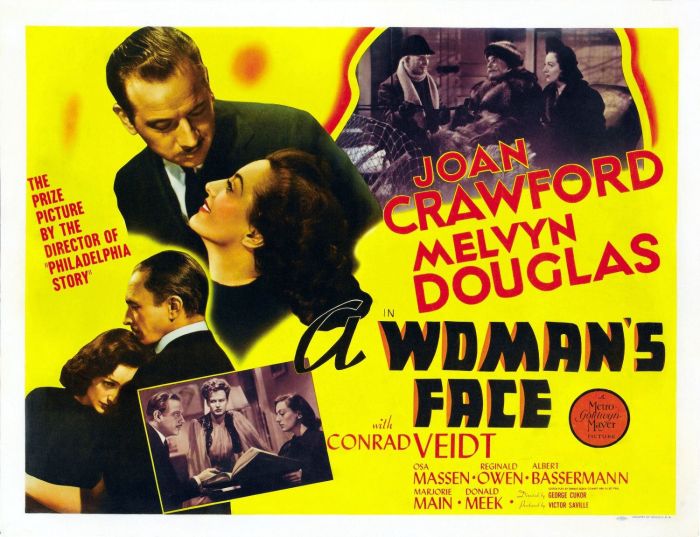
A Woman’s Face is a early film noir from 1941 starring Joan Crawford. The film is directed by George Cukor. The movie is a remake of a 1938 Swedish film starring Ingrid Bergman. I have not seen this original film, but wouldn’t it be fun to watch both of these back to back and see what great actress you like best in this role?
This film starts out with a trial scene. We meet a number of witnesses as they get ready to testify. Soon we find out that Crawford’s Anna Holm is on trial for murder and the witnesses are telling the story in flashback fashion to lay out the what has happened. We don’t even know who Anna has killed until late in the film to add to the tension.
Anna is the head of a blackmailing gang and is a bitter woman. Her face is badly scarred and she hides it as much as possible. You can see where her anger comes from and why she is so evil. She looks as ugly on the outside as she feels and is on the inside.
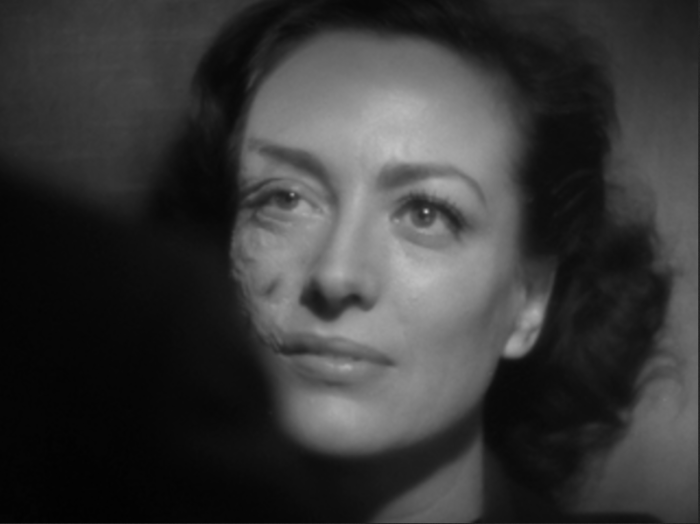
When a blackmail victim turns out to be married to a plastic surgeon and he is willing to fix her face, things change. Now that she is beautiful on the outside will she change on the inside? Can she start a new life with her new face? Is the evil always there boiling underneath, trying to get out?
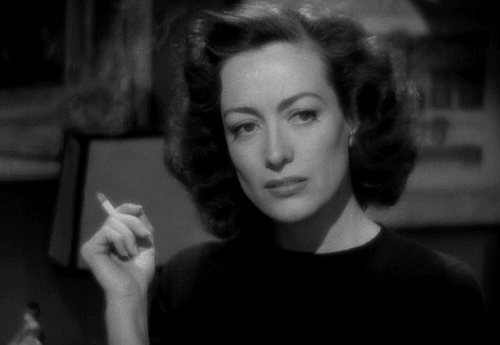
I got to admit I liked the first part of this film much better then the second half. When Crawford is an evil ring leader of a group of blackmailers, she is much more interesting then the governess of a small boy later in the film. Though there are some tense scenes and you know a crime is going to happen, it did lose some of my interest through this second half. Though watching Crawford’s performance of a Jekyll and Hyde type character makes this film worth watching.
This is not like most film’s noir and has a bit more of a Hitchcockian feel to it. This was made in 1941 and is early in the classic film noir cycle, so this doesn’t have some of the tropes that we are usually looking for, and that may be a good thing. If you are looking for something a bit outside the box of film noir, this may be for you.
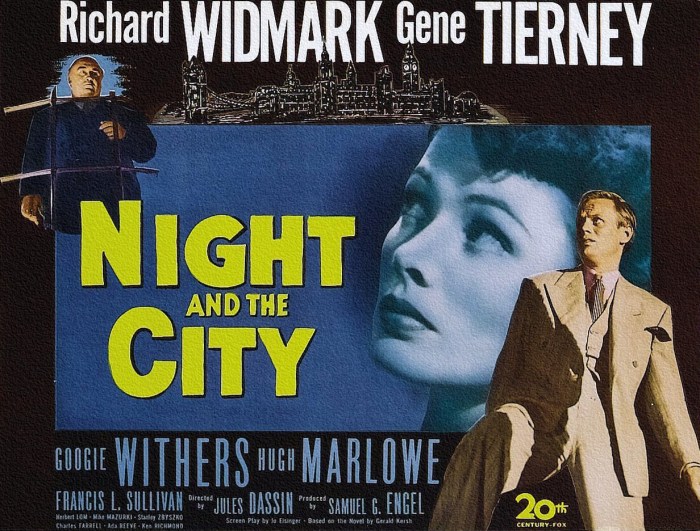
The Night and the City is a film from one of film noir’s greatest directors, Jules Dassin. Dassin was a target of the Communist hunt in Hollywood and was sent to London to start filming this film to get him out of the country. This was his last Hollywood film for years after being put on the blacklist. He left for France where he made a few more classic films, before his return to Hollywood.
There is two versions of this film, one is a shorter American version and a longer British edit. I watched the shorter American cut, which seems to be Dassin’s preferred version because of it’s tighter edit and more clear dialog.
This film stars Richard Widmark and his signature laugh. He plays a street hustler in London, using anybody and everybody he meets for money or a way to get ahead. The film starts with Widmark’s Harry Fabian running at night through the city as somebody chases him. He runs to an apartment building, and seems to have lost all the stress he was just under. He enters the apartment and soon is riffling through a purse looking for money. Mary played by Gene Tierney is seen coming out of the shadows. Mary and Harry are a couple and Mary is tired of his hustling. She gets him the money Harry owes the man chasing him and Harry is free to start his next hustle.

Harry gives us a tour through the underworld of London and we meet a number of con men, hustlers and shady business owners. Harry uses a number of these people to get ahead on his latest ploy. Googie Withers and Francis L. Sullivan play a dysfunctional wed couple that will cross each other for love and hate. Harry’s latest scheme involves starting his own pro wrestling promotion. Herbert Lom plays the current wrestling promoter in London and will do whatever he needs to eliminate the competition.
This is pretty unique in we get wrestling instead of boxing as our noir sport of choice. This seems to mirror how wrestling territories where back in this time, as well as showing the move from traditional wrestling to the entertainment wrestling we have today. Ex-pro wrestler Stanislaus Zbyszko plays the old guard, wanting to keep the art of traditional pro wrestling alive. Unfortunately this was the only screen appearance by Zbyszko, who is great in this film. Zbyszko in real life echoed his on screen character.
Mike Mazurki was also a pro wrestler and plays The Strangler. The Strangler is the big draw in London and is part of the new guard of entertaining wrestlers Zbyszko’s character thinks is destroying the art of wrestling. Mazurki moved from wrestling to the movies and was one of the first actors to be type cast as the heavy or thug and had a film career that lasted over 50 years.

The inevitable wrestling match in this film is amazing. The scene lasts over 4 minutes and is one of the best fight scenes in film noir. This is a very complex film with may reasons to view it. It has one of the most brutal and heart wrenching ending in classic film noir.
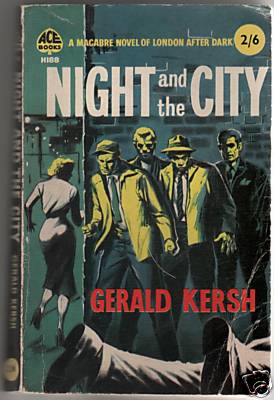
This film is based on the book by the same name written by Gerald Kersh. This book was originally published in 1938 and was kicked around for years in Hollywood. A lot of this had to do with timing, the book is very dark and shows crime in a very different way then audiences were used too. Thanks to a long run of film noir, Hollywood decided the public was ready. I have not read the book, but from my little research, it appears the movie varies from the source material for a number of reasons.
This film was also remade in 1992 starring Robert De Niro and Jessica Lange.
I loved this film and think it is required viewing for any film noir fan, classic movie fan and I feel pro-wrestling fans or those that would like to learn more about pro-wrestling will enjoy this as well.

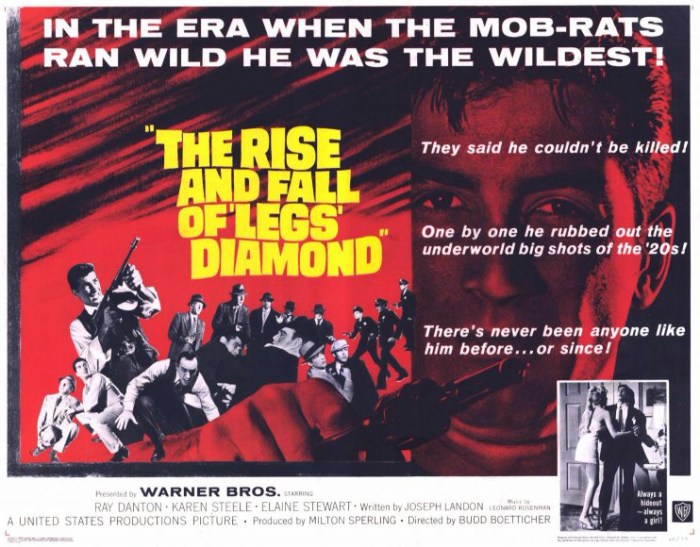
From director Budd Boetticher in 1960 comes the story of real life gangster Legs Diamond. This film is a mix of fact and fiction of the legendary mobster. Legs was an Irish American who was born in Philadelphia. He was known to be a great dancer, hence the nick name Legs. He also had been shot numerous times over the years only to live to tell the tale. He may have also got the Legs nickname for being able to outrun assassination attempts. He was a womanizer and willing to do whatever it took to get ahead.

This film covers all the highlights talked about above about Legs. Legs is played by Ray Danton for this film. It opens with Legs and his sickly brother played by Warren Oates getting caught in a drive-by shooting. This gives Legs the idea to steal a necklace out of a jewelry store near the shooting. He quickly picks up a dance instructor played by Karen Steele to be his alibi. He takes her to a movie and excuses himself. While he is out he uses the theater’s skylight to get into the store and steal the necklace. This opening shows Legs and his brother as small time crooks who are just trying to get by.
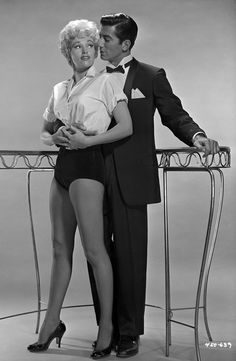
Legs goes to jail, but convinces the dance instructor to get him out by marrying him and traveling as a dance duo. Legs soon sees Gangster Arnold Rothstein and does everything he can to get into his inner circle. From here Legs uses his cunning, toughness and brutality to get to the top of the mob world. Will he get to the top? Will somebody take him down? Will Legs ever be happy?

Legs makes for a unlikable lead character with little to no redeemable qualities. With all this said we still root for him through out the film. A decent anti-hero that most will enjoy watching.
This film rode the coattails of other true crime drama’s about gangster that became popular in the early 1960’s. The Untouchables television series may have been the catalyst for this explosion of popularity. Legs did appear as a a character on that series as well as the television series The Lawless Years. This film was also adapted for Broadway in the late 1980’s.
Film noir buffs will enjoy this film as well as Mobster history fans. It is well directed and well acted, though we have seen this basic plot line many times in pre-noir gangster films, I guess it is true that history repeats itself.
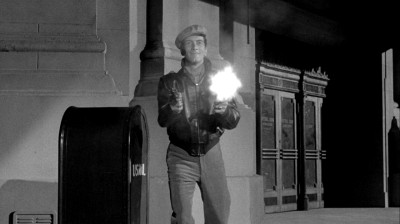

One of classic film noir fan’s favorite Femme Fatales had a bit of a noir like personal life. Karina Longworth has written an intriguing article about the life of Gloria Grahame. It is well worth your time to read the entire article here:

The Prowler from 1951 is a classic film noir from director Joseph Losey. This was one of Losey’s last Hollywood productions before fleeing to Britain due to being accused of Communist activity. I touched on this a bit more in my review of Time Without Pity here:
https://everythingnoir.com/2015/11/28/review-time-without-pity/
Dalton Trumbo was one of the writers on this film as well. Trumbo had his own problems with The Special Committee on Un-American Activities. This is the subject of a new film starring Bryan Cranston, a film I look forward to seeing as soon as I can.
The Prowler stars Van Heflin as a beat cop and Evelyn Keyes as a bored housewife. The movie starts with a prowler spooking Keyes’ Susan. Heflin’s Webb and his partner answer the call to investigate. Both Susan and Webb are from Indiana and have a common history, but neither seems to know the other. This is the start of, us as the audience, not trusting one or both of our characters. I have to say both actors play their roles well, we cannot get a read on either of these characters at first. Is Susan using Webb to get away from her husband? Does she know who Webb is and has always been in love with him, going all the way back to growing up in Indiana? Is she a calculating femme fatale? Webb is a cop that wishes he had Susan and her husband’s money and lifestyle. He hates being a cop and wants to get out of the job to make his mark somehow. Is he using Susan for her money? How far will he go to get it?
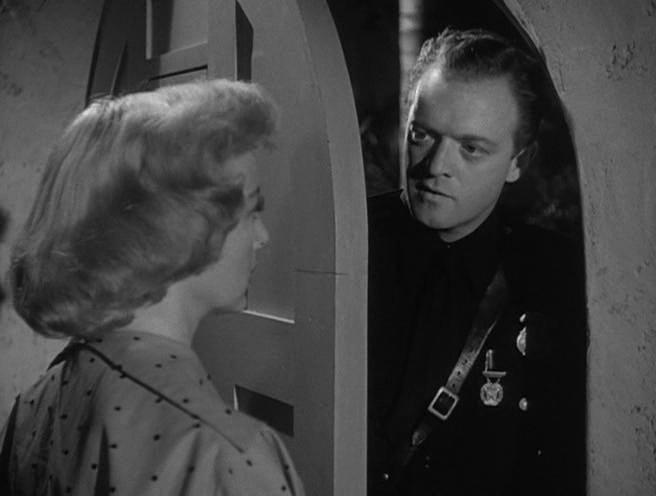
This film will take you on a roller coaster ride of good luck to bad timing to our character’s just digging a deeper hole all the way to the end.
James Ellroy loves this film and introduced it at screening like this”In 1951, Joseph Losey and Dalton Trumbo struck a masterpiece of sexual creepiness, institutional corruption and suffocating, ugly passion. You will need antidepressants, booze, drugs and bleak anonymous sex after you see this movie and—believe me—you are in the perfect city to find that! The great Dalton Trumbo wrote it, the great Joseph Losey directed it, Evelyn Keyes and Van Heflin in The Prowler.” I seen this on TCM and in the opening credits Ellroy was thanked for his help in getting this film restored.
This is a very good noir that every film noir fan should see. Enjoy the ride all the way to the bitter end.
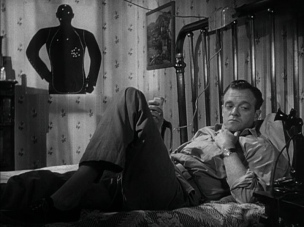
Favorite Tidbit: Even though Dalton Trumbo was already on the Blacklist at this point, he wrote the story under the pseudonym, Hugo Butler. He is also the voice on the radio (Susan’s Husband) through out the film.

The Woman on Pier 13 is a film noir released in 1950. In 1949 it was released in Los Angles and San Francisco under the title I Married a Communist to a poor reception, hence the name change before its more wide release.
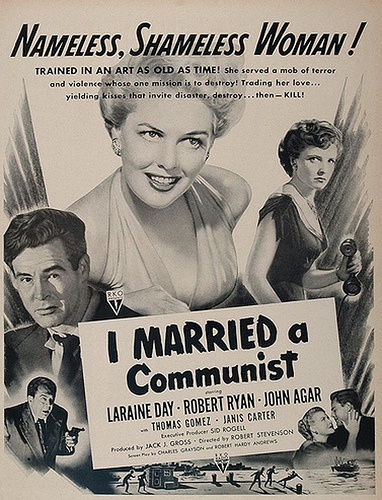
This film was directed by Robert Stevenson, who directed a number of lesser known film noir through out his early career before finding a home at Disney and directing some of their classic live action film.
The film stars one of noir’s greats, Robert Ryan as Brad Collins, who has just got married to Nan, played by Laraine Day. While on their honeymoon they run into Christine, played by Janis Carter. Christine is a bit of a femme fatale for this story and has a past with Brad when they both lived back in New Jersey. We soon learn both were part of the Communist Party back in New Jersey and Christine still is. With Brad now a big wig with the dock workers, the Party wants to use him to their advantage.

Will Brad be able to break his ties to the “Party?” Will Christine bring him back into the fold?
John Agar plays Nan’s brother and is involved with the union, Thomas Gomez plays a higher up in the Communist Party, and look for William Talman as hired muscle for the Party in one of his earliest film roles. My surprise standout for this film is Janis Carter who starts out as a classic femme fatale and grows more of a heart as the film goes on.

This film was a very good noir worth watching if you can see beyond the propaganda against the Communist Party. This film portrays the Party more like a heartless Mafia organization then a political party. Some might find the way the Communists are viewed as a nice time capsule to how afraid American’s where of the Reds. Robert Ryan is great as always in his role as a man that made a mistake in his youth and has to pay for his past sins.
If you are a fan of Robert Ryan and other small budget film noir for R.K.O. you will find this one just as entertaining.
 everythingnoir