Essay: WHEN SEXUAL MANIPULATION IS THE MOST FEMINIST MOVE OF ALL

Amanda Fortini over at Elle makes a case for the femme fatale. This is a very interesting take on the femme fatale, coming from a women in today’s world. She looks at the femme fatale from the classic films noir as well as the ones she grew up watching in the 1990’s. This is worth reading and you can read the full essay over at Elle here:

http://www.elle.com/culture/movies-tv/a30815/femme-fatal-essay/?utm_content=buffere7812&utm_medium=social&utm_source=facebook.com&utm_campaign=buffer

Review: Cause for Alarm!

Cause for Alarm! is a classic film noir from 1951. This film is directed by Tay Garnett, who returned to his noir roots 5 years after The Postman Always Rings Twice. Though these are two very different films and Postman always gets the attention from noir fans, this film holds up on its own.

This film revolves around Loretta Young’s Character, Ellen. Ellen’s husband, George, played by Barry Sullivan is very ill and is bed ridden. This film starts out with Ellen doing housework and with a classic noir voice over, Ellen starts to tell the story of the worst day of her life. The film flashes back to when Ellen worked for Dr. Ranney Grahame, played by Bruce Cowling and meets the Doctors good friend George. This flashback has a bit of romantic comedy feel to it, but as we return to the main story, things start to get very dark. We find George is having some strange thoughts about his old friend, Dr. Grahame and his wife. Is George right or is he imagining things in his sickened state? Is his Wife and Doctor trying to kill him?

I really enjoyed this film, but feel most non-film noir fans will not. Though this has some comedy elements in it, especially the flashback scenes, it is a very claustrophobic film with pending disaster at every corner. That being said it definitely has a feel of a modern situation comedy. In fact this film was cribbed from for an episode of Three’s Company. I feel a remake of this film would be very difficult to do in today’s cinema with the same sense of frustration and pending doom. This film is also unique in taking the traditional noir back streets of the big city out of the story and slapping it into suburban America.

Favorite Tidbit: Loretta Young has a great performance in this film, and she worked really hard to earn the role. Her husband, Tom Lewis, was the producer of this film and wanted Judy Garland for the role. Young wanted the role so bad, that she got a lawyer who told Lewis, he was discriminated against Young because she was his wife. He folded and finally hired his wife for the role.

Re-Watching: Scene of the Crime

Scene of the Crime is a classic film noir from 1949. I watched this a few years ago and recently re-watched it when I caught it on television. This film is directed by Roy Rowland who had made a few B-movie films noir over his career.

This story is a fairly simple one, the first scene shows a couple kissing and a man talking to a store clerk. The man talking to the clerk is shot and killed by a killer with a twisted hand and a marked up face. Our hero Mike Conovan played by Van Johnson is soon on the case. He is happily married to Gloria, played by Arlene Dahl,but as he gets deeper into this case, it starts to strain their relationship. It doesn’t help that Mike is getting close to showgirl Lili played by Gloria De Haven. As the case continues, Mike looses informants and friends, but continues to dig for the truth. Will he like what he finds?

Van Johnson’s voice, attitude and size make him the perfect hardboiled detective with a heart of gold. The cinematography is spot on with some amazing shots on the street, even though they look to be on a sound stage. This is a good film noir worth checking out for film noir fans. It is an enjoyable little film, with a bit of a twist ending.

Article: ‘Thief’: lost Alain Delon/Ann-Margret film noir

Here is a film I have never heard of, but since it has recently been released on DVD I will be looking for a copy soon. This is Alain Delon’s first American film and also stars Ann-Margret making for an interesting duo. Here is a full review of the newly released DVD over at ctnews.com:

‘Thief’ lost Alain Dolon Ann-Margret Film Noir

After reading Joe Meyers’ review of the DVD, I did a little more research on this film and see it also stars noir greats Van Heflin and Jack Palance. Sounds like a film I need to see soon! Who has already seen this film? What are your thoughts?

Review: The Garment Jungle

The Garment Jungle is a classic film noir from 1957 mostly directed by Robert Aldrich, who did not get a credit for his work, and was completed by Vincent Sherman. This was also Sherman’s first directing credit in 5 years do to his name being on the gray list.

The stand out performance from Lee J. Cobb here is not surprising. He plays the owner of a garment manufacturer in the garment district in New York. Though this film came out the same year as Cobb’s most famous performance in 12 Angry Men, I could not help but notice some similarities to his performance in Thieves’ Highway. In both films he plays a man in charger and tries to keep the working man down. He is way more corrupt in Thieves’ Highway, and in The Garment Jungle he turns a blind eye to what is going on. Both films take a look at workers rights. Here is my review of Thieves’ Highway:

https://everythingnoir.com/2015/08/23/review-thieves-highway/

These two films would make an interesting double feature, looking at a similar problem in two different industries on opposite coasts.

This film starts out with an argument between two partners, Cobb and his partner are discussing what the workers should be paid. Cobb is against the union and his partner is for it. His partner walks away and gets in the elevator. The elevator fails and his partner falls to his death. Cobb’s son, played by Kerwin Mathews, comes back to town and wants to work with his father. When a confrontation between a union organizer, played by Robert Loggia and Cobb happens in front of Mathews on the factory floor, it gets Mathews thinking. Mathews goes to Loggia where he meets the union organizer’s beautiful wife played by Gia Scala. The three work together to break the mob, which is behind trying to keep the company union free and hired by Cobb for protection. The situation escalates and soon turns violent. Will the mob break the union or will the union break the mob? Will Cobb finally look at employees rights or will he continue to support the mob? Who will survive and who will die in this war between the two?

Richard Boone plays the mob boss Cobb has partnered with and Wesley Addy plays the head thug for the mob. Both are great in their evil ways.

Besides Cobb’s performance, Robert Loggia’s performance is well worth checking out. The dynamic between him and his wife are very interesting. Even though he is a good man trying to do what is right, he has his dark side. I really got a vibe that he beats his wife even though he was madly in love with her.

His wife played by Gia Scala is also very good in this. Scala had a short career and looks to have had a hard life with bouts of depression and turned to drugs. This eventually ended her life at a very young age.

The Garment Jungle is a good classic film noir worth checking out. It is an interesting time capsule of the union movement in the 1950’s. It is especially interesting to look at the clothing industry then and compare it to how it works now.

Re-Watching the Classics: Dial M for Murder

I have been reviewing movies on this site for almost 10 months now and this is the first film I have looked at from one of the greatest directors of all time(some may say there is no question he is the greatest). I will have to say that Alfred Hitchcock is the reason I started watching classic film noir. I seen Rear Window and wanted to see more films like it and if it had Grace Kelly in it…all the better. This lead me to more Hitchcockian films and film noir. Some may argue this is not a film noir and they maybe right, it might be an early neo-noir? I’m not sure how you would classify it, all I know is it is noir.

This film is based on a play by Frederick Knott and was released in 1954. It revolves around a very small cast of characters with most of it taking place in a small apartment in England. The film starts out with Tony, played by Ray Milland and Margot played by Grace Kelly in what appears to be a happy marriage. This scene even has background music more akin to a Walt Disney movie then a Hitchcock film. After we see the kissing couple we go to the next scene with Margot kissing…a different man. This man is crime writer Mark Halliday played by Robert Cummings. This film has great dialog to tell the story as we find out Margot and Mark had an affair and Margot would have left her husband, but he has changed since Mark has been gone and now she is conflicted. In the next scene Tony has Lesgate (or is it Swann?) played by Anthony Dawson, come to the apartment to talk about selling his car. This is where Tony tells Lesgate his perfect murder and how and why Lesgate will kill his wife. When Tony and Mark go out to dinner, Tony steps away to call his boss, but he is really calling his wife so she will be in position to be murdered by Lesgate. When Margot fights back and kills Lesgate in self-defense, Tony has to change his plans, but this may still work for Tony.

When Chief Inspector Hubbard played by John Williams gets involved in the case the tension gets cranked up a notch. With Millard and Kelly at the top of their game and Hitchcock doing some of his best work I don’t think there is any question this is an all time classic and should be watched by every movie buff. I can not imagine any fan of noir not finding this film entertaining.

But, is this a classic film noir or not? This is part of the fun of the noir genre as it is a genre with a lot of different takes on how it is classified. Other genres you recognize as soon as you watch them, Westerns, Science Fiction and Horror are easy to spot. Some people will look at a film and call it a film noir and some might say it is just a crime film or a thriller or maybe a murder mystery. Here are some argument points for and against this being classified as a film noir.

FOR:

The main character of this film is a bad guy trying to pull off the perfect crime.

It has a very claustrophobic feel with most of the film taking place in a small apartment. Also both our main characters are prisoners in a marriage they do not want to be in anymore.

Characters like Margot and Lesgate have choices, but none of them are good. Tony also seems to be stuck in a situation he can not get out of, once Lesgate fails to complete Tony’s original plan.

This film does not have a happy ending for many of our characters, I will not go in-depth here because I do not want to spoil it for those that have not seen it yet.

Though Hitchcock used many techniques in filming this movie, he did go to the classic film noir well in quite a few scenes:
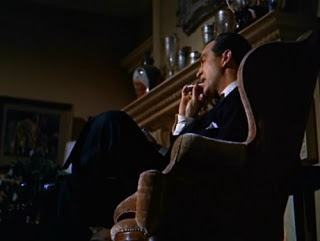
Like this one where he uses shadows and a fish eye point of view.
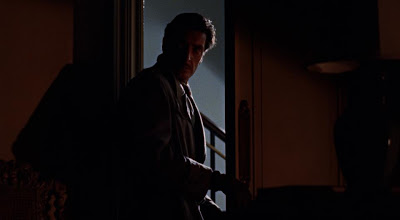
And the complete murder attempt is shot in the shadows and gives a very black and white feel.
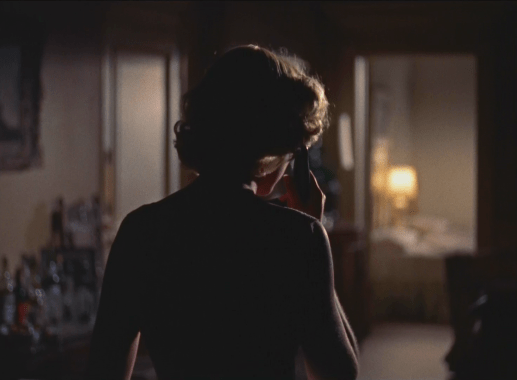
AGAINST:

Some say film noir can not be filmed in color, though this is not the norm, I have seen a few films in color that are considered film noir by many.

Grace Kelly character isn’t a femme fatale. This is true and some say every film noir has to have one. I don’t like this rule, though I love a good femme fatale, I believe there are plenty of great film noir movies without one.

I would love to hear more points from you on FOR or AGAINST this being a film noir.  Leave your point of view in the comments below.

Favorite Tidbit: Though this is almost always shown in 2D it is actually Hitchcock’s first and only attempt at 3D and was completely filmed in stereoscopic 3D. Now this is a Blu-Ray 3D I would love to see released.

Update: This has been released on Blu-Ray 3D and is available.

Article: EVOLVING VERSIONS OF FILM NOIR EXPLORE TODAY’S UNEASY FEELINGS by Roger Ebert

I came across this article written by Roger Ebert in the mid 1990’s. It’s about how popular, noir films are today and how they have changed from the classic era. It looks at many of the great neo-noir films of the mid 1990’s and breaks them down into three different categories: Classic Noir, Deadpan Noir and Neo Noir. This is a great article and talks about some films I have not revisited in a long time, but really want to take another look at them now. What do you think of the three types of noir and do they still hold up today, 20 years later?

http://www.rogerebert.com/rogers-journal/evolving-versions-of-film-noir-explore-todays-uneasy-feelings

Re-Watching the Classics: Cat People

Cat People from 1942 is a cult classic for many reasons. It has a following from film noir fans, horror fans and fans of well done B-movies.  Credit for this can be given to Val Lewton and this production of his very first film. Val Lewton used a bunch of techniques in filming and storytelling that gave him a signature style. R.K.O. gave him a small budget to make some horror films to try to compete with the Universal Monster films. Lewton took the opportunity, but ran with it in a slightly different direction. Lewton had this picture directed by Jacques Tourneur, who he used on his next few projects as well. Tourneur went on to direct his fair share of classic film noir films with his high point being Out of the Past.

This film revolves around Irena Dubrovna played by Simone Simon. She believes she is cursed and will harm any man who falls in love with her. She believes she will turn into a large cat and kill! When she catches the eye of Oliver Reed, played by Kent Smith, she has feelings for him as well. They eventually get married, but things soon start to change as Oliver is not happy in his marriage. Irena goes to a psychiatrist, played by Tom Conway, to help her overcome her fears and save her marriage. To make things worse Oliver and co-worker Alice Moore, played by Jane Randolph, start a relationship. This angers Irena and she starts to stock both of them. Does Irena really turn into a large cat or is she just going crazy? Will Alice and Oliver survive either way?

The film noir techniques used in this film are both beautiful and suspenseful. I particularly liked the swimming pool scene and the scene in the drawing-room also works well. This film would be the first time for the use of the “Lewton bus,” I will not explain that here as it may give away to much of the film, if not in story but feel. This film became a huge hit for R.K.O. and ran in theaters for a long time. In fact some critics wrote bad reviews for this, but because it was in theaters so long, some critics re-watched it and retracted some of those bad reviews. It also caused the next two Lewton films to be put on the shelf until Cat People’s theatrical run was over. Lewton’s filming style and way of making film was a big influence on film noir to come and film in general.

Well worth checking out to see how great a cheap B-movie can be done. This is a fun little film with some great performances and a twist at the end which still works today.

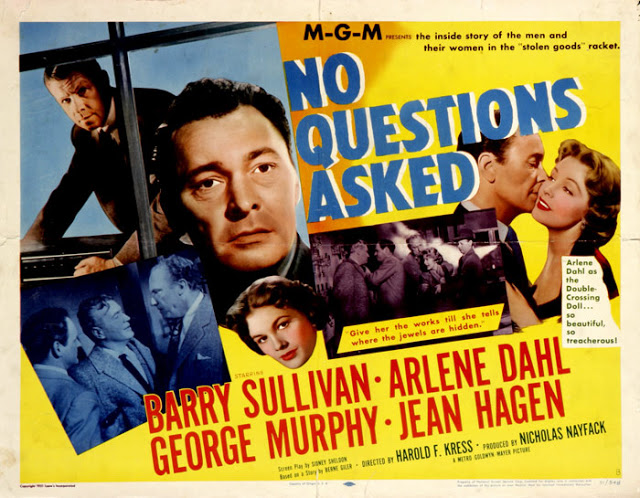
Review: No Questions Asked

No Questions Asked is a classic film noir from 1951 directed by Harold F. Kress. Kress never really made it as a director, but went on to edit some classic Hollywood films. This has a story from Berne Giler and a screenplay from Sidney Sheldon, both had long careers as writers in Hollywood.

Our story starts out with Barry Sullivan playing Steve Keiver, an insurance investigator. He is in love with Ellen, played by Arlene Dahl. Ellen is a bit of a gold digger and wants to marry somebody with money. She soon disappears to go marry a rich man with no warning to our hero. Keiver buries himself in his work and becomes very successful. He works connections in the underworld to recover stolen property for his company. He soon finds the eye of Joan, played by Jean Hagen. She is madly in love with Keiver, but Keiver still has feelings for his old flame Ellen. When Keiver and Joan are at a fancy party it is robbed. This part is pretty interesting as the theft was performed by men in drag. They fool all of those they rob by gun point, and puts the police on the trail of “two attractive females,” instead of two males. This brings in Police Inspector Matt Duggan, played by George Murphy and Detective Walter O’Bannion played by Richard Anderson into the investigation. Our hero works both sides of the law to recover the million dollars worth of jewelry stolen at the party. Will he be able to work his usual magic to get the job done? Will he be double crossed or even framed? What girl will eventually win his heart? Who can he trust?

This film noir is a bit of a hidden gem! It has a great plot with some good acting. I thought this was a sold film worth your time. The gangsters are unique and the heist men who are cross dressers had to be a bit risqué for 1951. Especially since these cross dressers are not comic relief, but actually fool the characters in the film and I think they would have fooled most of the movie going public.