Review: The Strip

The Strip from 1951 is a different film noir than most. This film has a small noir tale to tell, but the tale seems to just be there to get you from one song and dance number to the next. People who are fans of the music of the era will love this film.

This film revolves around Mickey Rooney who has just got out of a mental institution. He soon gets a job selling “insurance” for a local gangster played by James Craig. He soon gets the chance to chase his passion of playing drums at a club on the strip in Hollywood. Fluff, played by William Demarest, owns the club and is Rooney’s father figure for this film. He soon falls for Sally Forrest who is a cigarette girl and dancer at the club. Rooney soon has plans of marriage, but Forrest is hoping to improve her career in the entertainment industry by trying to get into the movies. Rooney, wanting to keep Forrest happy, introduces her to his old gangster connection, Craig. Craig says he has connections in the movie industry and will help Forrest get into the movies. Will Rooney lose his girl to his old gangster friend? Will Forrest ever get into the movies?

All this is happening as we see performances from Louis Armstrong, Monica Lewis and Vic Damone. We see Rooney on the drums and Forrest doing dance numbers as well. This is a very entertaining film because of the music and dancing, but falls into the average film noir department.

If you are a fan of Rooney, Forrest or some of the musical acts that perform, I think you will love this film. If you are looking for a very dark film noir, skip this one.

Article: The Modern Noir Has Atrophied

Angelica Jade Bastién has written an interesting article over at Vulture. She looks at neo noir and what is missing from it lately compared to the classic noir period. She gives a very interesting point of view with some great information. Though I don’t agree with everything she has to say, it does make for some interesting reading and discussion.  What do you think of her take on noir and neo noir?

http://www.vulture.com/2015/08/noir-has-atrophied-its-not-all-true-detectives-fault.html

Article: The 100 Best Film Noirs of All Time

Paste has made a list: “The Best Film Noirs of All Time”. This list mixes in classic film noir with more modern neo noir films for an interesting list. I like the films on the list, but may disagree with the order. What do you think of the list? How many of these films have you seen?

http://www.pastemagazine.com/articles/2015/08/the-100-best-noirs-of-all-time.html?a=1

Re-Watching the Classics: Angel Face

Angel Face is a classic film noir directed by Otto Preminger from RKO while Howard Hughes was the head of the studio. The story revolves around Robert Mitchum who is an ambulance driver and a young women with issues played by Jean Simmons.

This film starts with Mitchum as an Ambulance driver, on a call at a mansion. The lady of the house had a close call with a gas leak, but seems OK now. Mitchum goes down stairs and talks to Simmons, this is where the infamous slapping scene happens.

Hughes was not happy with Simmons and put her in this film at the end of her contract. He hired Preminger to make her life a living hell. Preminger made Mitchum slap Simmons over and over again to get the right take. Mitchum finally walked over to Preminger and slapped him full force asking if that is the way he wanted it. Simmons later in life still could not watch this film because of the hell she went through making it. The only thing she loved about this film was Mitchum.

In the film Simmons befriends Mitchum and gets him a job as the driver for her Father and Step-Mother. Soon her Step-Mother and Father dies in a horrible car accident. It looks like the car was sabotaged and our couple is the prime suspects.

Simmons plays one of the best femme fatale in noir history in this film and Mitchum is great as always. The ending is one of the bleakest of all time as well. The story is good and over all the film is above average. Well worth your time if you are a fan of film noir or one of the two stars.

Favorite Tidbit: Simmons cut her hair short, knowing Howard Hughes hated his leading ladies having short hair. She thought this would get her out of her contract with RKO. Instead Hughes made her wear a horrible wig through out this film.

Review: A Cry in the Night

A Cry in the Night is a film noir from 1956 directed by Frank Tuttle. The three stars are:

Edmond O’Brien playing a detective and father

Natalie Wood playing O’Brien’s daughter

though the poster says the third star is Brian Donlevy, playing the detective in charge of the case, the real third star of this film is Raymond Burr playing a psychopath.

This story starts out with Wood and her boyfriend, played by Richard Anderson, up at “Lover’s Loop” parked in his car. They are discussing their future together when the boyfriend notices a man in the trees watching them. He goes to investigate and a scuffle ensues. Burr hits the boyfriend with his lunch box. The boyfriend goes down and Wood comes over to see how he is doing. She thinks he is dead and Burr carries her away and steals the car. When the police find the boyfriend, they think he is drunk and throw him in the tank. A doctor at the police headquarters discovers him and brings him into Donlevy’s office to tell his story. When Donlevy finds out Wood is the girl kidnapped, he goes to O’Brien’s house to inform him of the situation. This scene is interesting as O’Brien plays a fun-loving husband and father, drinking a beer and talking to his wife. When he is informed of his daughter’s kidnapping, he instantly turns into a hard-boiled detective.

The story takes place over the course of one night with a pretty straight forward plot. Burr is a pretty interesting character here as a mentally disturbed man who lives with his overbearing mother. Natalie Wood also stands out playing a teenager in trouble, but in the 1950’s she may have been the best at that.

This is a very good film noir worth checking out. It is a hidden gem and if you are a film noir fan you will find it very entertaining.

Favorite Tidbit: This film was from Jaguar Productions, a small movie production company that only lasted a few years. It was established by Alan Ladd. You can hear his voice in the beginning of the film in an uncredited voice over.

Review: Follow Me Quietly

Follow Me Quietly might be the freakiest classic film noir of them all! This film was made in 1949 and directed by Richard Fleischer. Noir directing great Anthony Mann helped with the story.

This story is a classic police procedural, centering around Police Lt. Harry Grant played by William Lundigan. Grant is on the case of The Judge, a serial killer who seems to attack his victims when it rains. Dorothy Patrick plays Ann Gorman, a journalist for a dirt rag. Grant is not a fan of the magazine Gorman works for and does not want to work with her. Gorman is charming and Grant finally agrees to help her as long as he is in full control of the article. When Grant can not get a decent lead on The Judge, he brings in a sketch artist to draw what they know. Then a dummy maker is brought in to do a life-size rendition of The Judge to help them identify him.

If you don’t find this kind of creepy, I don’t know what will. There is a scene with the dummy in a rain storm that will make you jump as well.

Jeff Corey is also very good in this film, playing Police Sgt. Art Collins. He is the voice of reason to Grant, as Grant starts to lose his mind with the pressure of the investigation.

This is a very good, short film noir and it is worth watching for all noir fans. It is also worth viewing to see how police procedures have changed and how they have stayed the same over the last 5 decades.  Not to mention the freaky dummy is worth the price of admission.

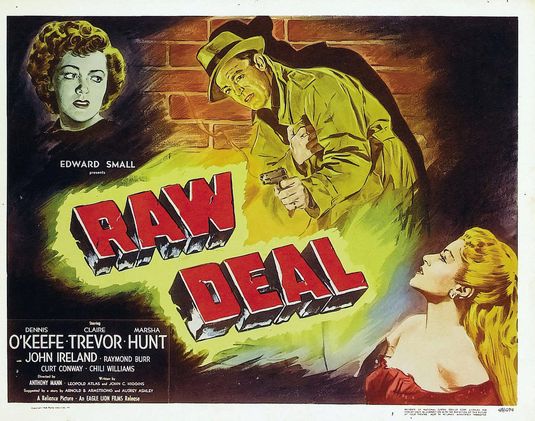
Movie Review: Raw Deal

raw_deal

Raw Deal is a film noir from 1948, directed by Anthony Mann who has directed a number of noir films before he moved on to Westerns.

Raw Deal has a very good plot, which incorporates many different plot devices into an hour and twenty minutes of dynamite. The main plot is a prison break but there is also a love triangle and a revenge theme thrown in for good measure.

Dennis O’Keefe is our protagonist who is in prison for taking a rap for crime boss Rick Coyle played by Raymond Burr. The film starts out with him talking in the visiting room with his legal caseworker played by Marsha Hunt. As she leaves, Claire Trevor playing our protagonist’s girlfriend is waiting to visit. We see the attraction and jealousy that will push this love triangle. A prison escape is planned with Coyle’s help, but Coyle knows his friend will never make it, at least that is his plan. When our protagonist escapes, he doesn’t have anywhere to hide out, so he goes to his caseworker’s house. Soon our love triangle goes on a road trip, trying to get away from the police and meet up with our crime boss who owes our hero $50,000. What woman will win our hero’s heart? Will he get away? Will he get his $50,000?

This is a very good little film worth watching for film noir fans. Though all three leads are well done, I have to say Raymond Burr is the stand out in this film for me. The scene where he throws a flaming liquid onto a female night club goer is one of the most vicious scenes I’ve seen in a while. Does this scene foretell his characters own fate?

Review: The Unfaithful

The Unfaithful is a classic film noir from 1947 directed by Vincent Sherman. The writing team on this film is the real story here. We have David Goodis teaming up with James Gunn for the screenplay. This is loosely based on the novel, The Letter by W. Somerset Maugham. Yes, that’s right, this is based on the same material as The Letter starring Bette Davis,which came out just 7 years earlier. Maugham was not given a writing credit for this film and the setting is moved from a rubber plantation to the urban setting of Los Angeles.

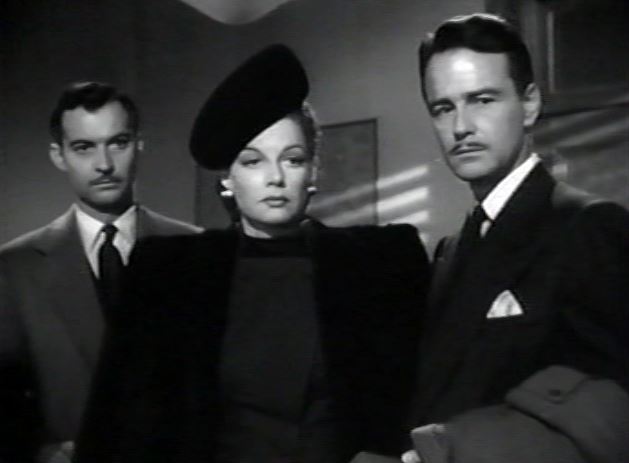
This film revolves around Ann Sheridan, who plays Chris Hunter. Chris is married to Bob Hunter, played by Zachary Scott, who is a war veteran and is now a business man in the housing business. He is out-of-town as our film starts, showing Chris on the phone with Bob as they make plans for the next morning when Bob comes home from Portland. Chris tells Bob she will be going to a divorce party for Bob’s cousin, Paula, played by Eve Arden. The party highlights Paula being proud of her new-found freedom, and everybody seems to be having a great time. Chris heads home in the middle of the night and as she opens her front door a shadowy character grabs her and shoves her in the house. As the viewer we witness the struggle through curtained windows and cannot tell exactly what is happening. Bob flies home and is confused when his wife is not at the airport to meet him. He calls home and soon grabs a taxi to rush to his house. He finds the police are there as well as his friend and lawyer, played by Lew Ayres. The dead body still sits on the floor of the home as the investigation continues. Chris is obviously distressed as she tells her story of self-defense. As our story continues we learn more about the victim and why he may have been there. Was this self-defense? Will Chris and Bob’s marriage survive this?

It seemed to me that this film is more than a mystery noir, but a real look at Post-War marriage. This shows a woman who was living by herself for two years while her husband was in the Pacific. The question this film asks is, can what happens in those two years be forgivable? Should the couple even tell each other what happened in those two years? Can a good marriage survive anything? We see one divorce at the beginning of the film showing a strong woman willing to go on in life by herself. I took Eve Arden’s character as a strong feminist, especially for the 1940’s, I would be interested in learning if the writers intended this or if she was to be perceived as something else.

The other thing that stood out to me is another great performance from Ann Sheridan. She really is hard to read in this film as our loyalty to her shifts from the poor victim to murderer and back again a number of times. In the end do we really learn the truth? Is she just another evil femme fatale or is she the victim of circumstance?

This film is a must see for fans of Ann Sheridan and would make for an interesting double feature with The Letter from 1940. I have not seen The Letter in a while, so I will not try to comment of the similarities and differences at this time.